Translate

Showing posts with label Poland. Show all posts

Thursday, August 13, 2015

Roots Tour Part VIII: From Przework east to towns she knew -- Jaroslaw and Przemysl


Feeling victorious after our historian produced the census records from a room right behind her office, we left the Przeworsk museum for the next town, about 15 minutes east: Jaroslaw.  It was a place my grandmother had mentioned. A quick hop by car train or horse, I think the doctor had been there.  An attractive little town, it had its own rynek, of course, and two repurposed synagogues still standing.

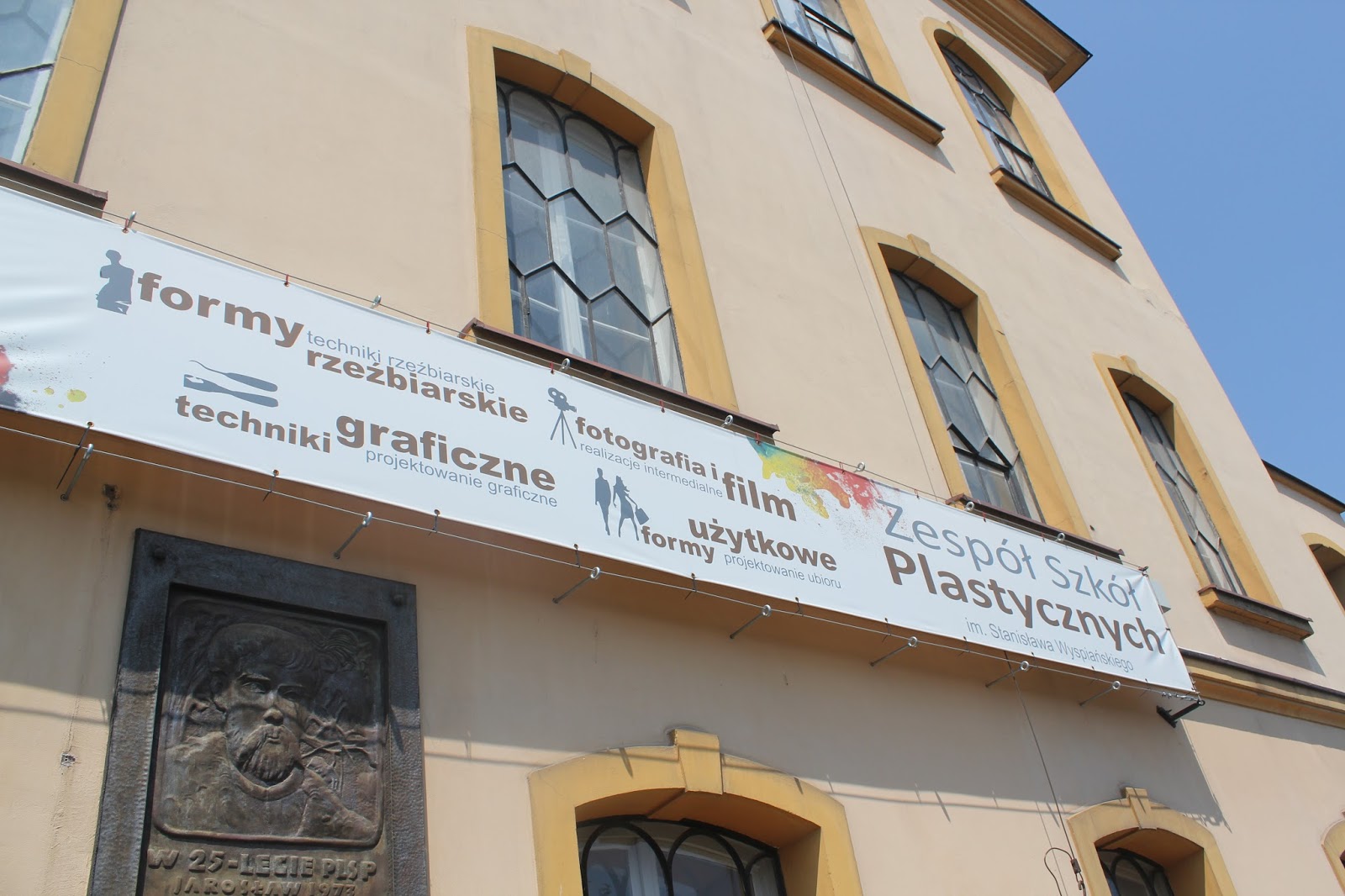
The plaque on the art school in Jaroslaw
Jakub took us inside one of them; it's been an art school for many years.  You can't tell it was a synagogue until you enter the soaring gallery of students' drawings and paintings. Then you see the high vaulted ceiling and recognize the arched windows, round and rectangular panes of clear glass where you know all the colors and the names of donors once drew the eyes of daveners. 


There's two plaques to bear witness; one of recent vintage, in Polish English and Hebrew, and an older one, in Polish alone.

 The school is on or very near Jaroslav's rynek, which also boasts a beautiful town hall, decked with plaques and statuary.


The other synagogue, the "new" one, is not being used for anything  now. Jakub said it was under new ownership.  This one had one extremely exceptional feature: the shape of the twin tablets on its pediment; a clear surviving sign of its original identity. Everywhere else we'd been so far, the Germans had been diabolically thorough about eradicating all signs of Jewish names or symbols.

Inside, the art school shows hints of its previous function.


Anyone speak Polish?  This appears on the town hall  in Jaroslaw's rynek. 


This is the former synagogue in Jaroslaw  that bears a rare surviving symbol.
We had lunch in Jaroslaw and proceeded on further east to Przemysl, a place my Grandmother refers to on a recording as a place "we knew we were already safe."  A small hilly city of three-story, ornately fronted buildings, winding streets and plenty of vehicular ad pedestrian traffic.  There we had an address from a document of the Committee for Polish Jews placing my grandmother's surviving nephew, age 2, and his mother, her sister-in-law, in 1946.

This multilingual sign describing Jaroslaw's history as a trade center typifies the Jew-free history taught all through the Communist era.  


Yes, that's a covered wagon, representing Jaroslaw's past to tourists
 as a way station among traders.  I thought those belonged to American history...  who knew? 


My husband and Jakub, chatting in Jaroslaw

On our way to that address, a mid-sixtyish local woman saw us on the sidewalk and me with my camera. Happy to see her town worthy of tourism, she eagerly asked me, through Jakub, what I thought of Przemysl. I said it looked like a nice, prosperous European city.   Along with translating my answer, Jakub asked her for directions to Przemysl's synagogues.  Although I didn't catch it, he told me that he saw her enthusiasm immediately cool. But she gave us the right directions.

Przemysl's synagogue was a big building in the middle of town; it had served first as a stable and later as a library.  Same denatured windows.  Blank old plaques where names had once been inscribed.  New historical plaques with contemporary donors.

The names erased from a place of honor
on the former synagogue of Przemysl.
The symbols chiseled off, the synagogue turned stable in Przemysl.
We left the shul and walked back the way we'd come, to find my great aunt's and second cousin's address; Mikiewicza 7.  It led to an old wooden door inside a courtyard, behind retail stores of leather goods and meat. Not neat or pretty. Weather-beaten and shabby, the door shared the courtyard with garbage bins and parked motorcycles.  People of the neighborhood asked us what we were doing there. I managed "aunt" and gestured "long, long ago."  That seemed to satisfy them.

Przemysl also has a surviving Jewish cemetery, which we visited inside its walls. With burials that dated up to 1944, its grounds near the entrance were obviously kept by someone who cared in 2015.

How was this graveyard spared? Jakub said that the Germans just couldn't manage to get to every one. They got close. The woods and underbrush were reclaiming the older stones, further back from the entrance and the road.

Two plaques adorned the entrance arch: one in Polish dedicated to a John J Hartman from the USA in 1999; the one on the other side in Hebrew and Polish to an Aharon (Arnold) Rabinowicz, who, says Google Translate,  built this wall and its iron gate in the year 1913.


Jakub had one more place he wanted to show us; something that would give us a sense, he said, of old Galicia. After at least an hour's drive through gentle Carpathian hills, that place turned out to be the curated historical village of Sanok.

 Something like Stockbridge, Mass., with admission building, tickets, map, it was assembled out of actual 19th-century, thatched-roof wooden houses and businesses salvaged from other towns around southern Poland,  mostly arranged around  a market square.  And just like a Stockbridge or a Waterloo, NJ, it had its blacksmith, apothecary, clockmaker, schoolhouse, church, weaver, tinker and teacher.

And less like a Stockbridge, it had its Jews. One Jewish house stood on the square, its front-room table set for Shabbes and papercut pictures hanging in the windows.

There was also a well-researched synagogue going up in Sanok this year,  reflecting the new tourism traffic and Jewish historical agencies at work in today's Poland.

We'd unfortunately gotten there at the end of the day. They let us in, just in time to see the watchmaker close up shop and a straggling school group get a double-speed, last-minute tour from a man who looked authentic to the place and period.  The kids looked like they could easily be from central New Jersey; that's  central and eastern Europe for you.

Finally, we and Jakub had dinner on the rynek in Sanok, after he showed us the surviving "private" synagogue of that little town.  You don't expect a Jewish presence in remote little towns in America, but there are ghosts of them in tiny towns all over Poland.  There's a historical reason for this; I think it's that Polish nobles wanted "their" administrative Jews everywhere to collect taxes for them.  Strategic to pick an unpopular minority that relied on the nobility for protection. 

Right next to our outdoor table was a coin-operated, one-seat kiddie ride; the kind of thing you'd see outside stores in my boomer childhood.  A little boy got in it, right next to his mom, and my husband offered the mom to do the shaking for him, Which he did, making the boy laugh.

The young mom spoke a little English. The little boy's name?  "Yosh."  What does he speak?  "He speaks Yosh."  We shared a little moment of the everyday sweet silliness of being a little kid's mom.


Thursday, July 23, 2015

Roots Tour in Galicia, Part VII: In which we find the one person in Przeworsk who could find a piece of proof


The three of us, led by Jakub, went into Przeworsk's Ratusz/town hall to look for records, as municipalities are supposed to hold those that are  less than one hundred years old. Older than that, and they go into regional Polish archives in bigger cities; in Przeworsk's case, Przemysl. 

The entrance to the Ratusz was now in the back, in a new addition whose construction was photographed the day Google came by in 2013.


Now it was finished and little kids played by the fountain.


We came to an office occupied by two women in their sixties; John Paul II's picture was on the wall.  Jakub explained the reason for our visit and they explained back, through him, that they couldn't help us; only marriage records were kept there.  We wanted another municipal office, they said; the one by the elephants. 

Elephants?  Were they pulling our leg?  We walked to Jakub's car, looking for elephants on signs or in store windows, then went a few blocks west on E40 until we came upon a pair of elephants on the road's grassy median. They were topiaries.  Cute green elephants, made of hedges, with red carpet saddles. And across the street from them was another office building, at the end of a flowery walkway, showing  Przework's by now familiar coat of arms, with the star and crescent.


Actually, I think there's something between Poles and elephants. They're a motif I saw painted on baroque  buildings in Tarnow and elsewhere.

Anyway, we entered this municipal building, whose halls looked just like town halls anywhere, with signs boosting  Przeworsk and everything that happens there, culturally, athletically, educationally, commercially.  We were directed up the stairs to another, smaller office, where two younger women, sitting at keyboards, also listened to our quest via Jakub. 
 
They were very sorry, but Przeworsk was no longer holding any town records; everything, recent to ancient, was now stored in Przemysl. Disappointing, but Przemysl was on our itinerary that day, anyway.  I saw a map of Przeworsk on the wall, the kind framed with squares of local advertising, and asked them if they had any more copies.  They apologized again.  We thanked them and went back down the stairs. 

Before we reached the first floor, the women called down after us and gave us the map from the wall, rolled up; a consolation prize.  I now have a nice map of Przeworsk and immediate vicinity, with the ads of many local businesses, mostly in home improvement, all around it.

Suzanne Wertheim's web page on Przeworsk had mentioned a local teacher, a Mr. Thomas, who had helped her identify old sites from pictures.  Jakub thought of inquiring in Przeworsk's public  library -- also conveniently located near the elephants.  I sat down at a PC and launched the familiar refrain of a Windows boot-up while he went to  ask the local librarians if they knew of this teacher.  Again, no luck.  And not much English, not even from the young civil servants. Sympathetic  smiles, at least. And Windows, in Polish.

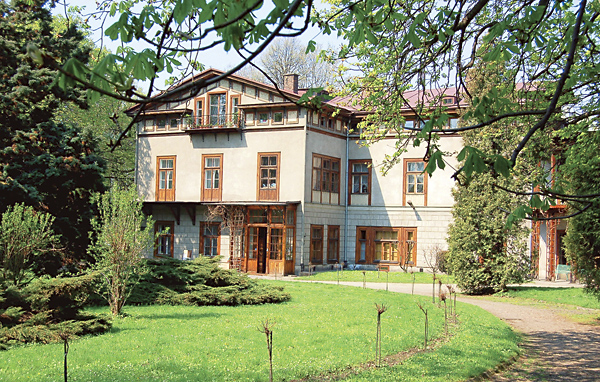
We were about to set out for Przemysl, the town after Jaroslaw, when I remembered that I'd seen a Przeworsk museum on the web.  That too, was nearby, in a park that had been another Lubomirski estate.   The museum itself looked like an old elegant country house.

I wasn't sure why I thought of the museum; I wasn't much interested in the case of surviving Judaica mentioned on their site; I know what menorahs and tefillin look like. Nor did we want to see any more aristocratic interiors, or the historical  firefighting exhibit. Again, another entrance, another explanation in the native language. 

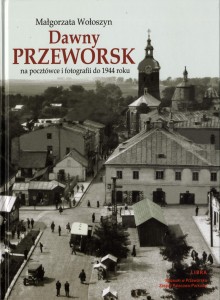
But this time we stirred up some enthusiasm.  Wait, let us get the local historian, they said. Turns out she worked upstairs.  Here, look at these books, in this case.  Here's a book of photos on the history of Przeworsk with a lot on the Jewish community, edited by this same historian. 

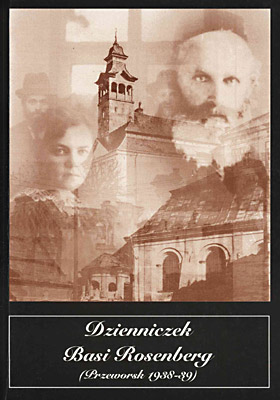
Here's another book; a diary, by the Anne Frank of Przeworsk, one Basia Rosenberg.  Well of course I bought that, and for only 8 zlotys.  Yes, it's in Polish.  I'm working on it. 

I would have been delighted to buy the book of photos, too, if that hadn't been their last copy. One of only 1000 or so printed,  it was out of print.  I'll be looking for it on Polish ebay.  We were ushered up the stairs to meet the historian, a woman somewhere near 40, I think, by the name of Malgorzata  (Margaret) Woloszyn.  She and a colleague were working on computers  in a cramped paneled room, and when we greeted her and explained our mission, she went into a back room and came back barely minutes later with some 95--to-100-year-old books of handwritten census records.

One book was an index to the others. And there, in those old lined but still sturdy pages, Margaret turned the pages to Schopfs and Schillers.  Including my grandmother, and her sisters, and brothers, and many cousins I never knew about, their birth dates, names and relation to their households, and the occupations of the head of the household, which was Krawic, or kravitz. This means tailor, which matched what I already knew.


We were all very happy, finder, researcher, interpreter/guide and husband. Here was proof, still in Przeworsk, that my grandmother, and therefore I and my family, had some connection to this town. 
 I asked her if she got visits like this much, from roots seekers, and she said that yes, she gets a few every year.

I was so excited that I took a lot of blurry pictures of the pages, and accidentally used the flash twice in spite of promising not to.  Some are sharp.  At least one page I'd like to ask her to reshoot and send me.

And I can, because I asked for her email address and she gave it to me.  I gave her my card and she stapled it into some kind of guest register.   And as soon as I finish this series -- or maybe even this post -- I'm going to write her, and Google Translate will do the rest.


The fact is that millions of birth, death, military and marriage records of Polish Jews are now searchable on the web.  I've found many and expect to find more. The Mormons gave Poland lots of money and resources to digitize all these records, in their dubious but indirectly useful effort to posthumously baptize everyone who ever lived.  So it doesn't really pay to spend too much of a short in-person visit in dusty archives.  Ms. Woloszyn herself said that these census books were going to be digitized as well. But there's still a satisfaction in seeing and smelling pages in ink and paper, in a tangible ledger, in seeing the names in that elegant turn-of-the-century penmanship. In being in the same general place where they were written, so long ago.

Now here's a really strange thing: The historian's last name, Woloszyn, is the last name of some of my husband's cousins. Bruce Wolosin, his third cousin originally from Cleveland, today lives in the same town we do and he and his wife are active members of my synagogue. Volozhin is a town once famous for its rabbinic learning. 

I'm sure this helpful historian isn't Jewish.   Jesus' picture hangs on her office wall, too.  But maybe, if you do some research...


Sunday, July 19, 2015

Roots Tour in Galicia -- Part V -- Przeworsk's Bus Station

The trip from Rzeszow to Przeworsk couldn't have been any more than forty five minutes, rynek to rynek (market square to market square). We were mostly on the same road the bus had taken to Count Potocki's Castle in Lancut, plus another ten minutes or so further east.  The weather was fine. Bennett and I peppered Jakub with questions all the way, about Poles and Jews today, about the shift in education after the fall of the Soviet Union, about his family, his girlfriend, his girlfriend's parents, his story, his current job, the masses of Hasidim he guides to former synagogues, other roots-seekers.

He stopped at the first sign marking the town.  Just a regular white-on-green sign, Przeworsk; just like Route 3 to  Passaic, NJ.  No grand lump rose in my throat.  I snapped the picture from the car.  It was just what I had expected, and the sign was so clearly of another Przeworsk, of another time, one where schools and restaurants and campgrounds meet you on the outskirts of a town so much bigger, more normal, better fed, and safer than the one my grandmother knew.  And of course, Judenrein.  Empty of Jews, who had once been up to 40% of Przeworsk.

The countryside was very pretty; lush green and mostly flat, with the Carpathian hills off in the southern distance.  In fact, the tourist brochures call this the SubCarpathian region.  It looked to me like flatter parts of upstate New York, with the same trees, the same wildflowers and tall grass, the same rolls of hay on open fields.  No wonder the Catskills looked so inviting.

Jakub took us first to the place where the maps indicate the former presence of a Jewish cemetery. Destroyed by Nazis, today it's the Przeworsk bus station, built during Soviet times.  I knew where to go before Jakub did, from many views on the web.  The little stone monument off in a grassy corner looked more worn up close. 


And the Polish inscription -- "Jewish Memorial" -- was barely legible, even to Poles, and the words below that even more ground down.  I knelt down to touch its crumbly surface, wondering which and how many ancestors' bones lay under the asphalt and concrete.

People sitting on benches, waiting for buses, didn't pay any attention to me that I could see.  Someone with a camera and perhaps a Jewish face, taking pictures and leaving pebbles must have been a sight they saw from time to time, maybe even with increasing frequency.  Somebody had already left pebbles on top; someone else had left a tinned yahrtseit candle, and someone else one of those reddish candle lamps you see at other Polish gravesites and monuments. The little monument was shaded by a few trees.

 It was a run-down bus station, at that, with skimpy shelters that didn't shade very well, and benches and railings in need of fresh paint.  Polish web sites (thanks again, Google)  report that plans to renovate the station have been hampered by the chief rabbi of Poland, who will not give permission to do any more violence to a Jewish burial site.   Nowadays this is a consideration.  Could they move the bus station?  It's right alongside the main road, choked with traffic. 

Again, it was hard to connect the physical place I saw, heard and smelled with the emotional place I had contemplated remotely.  Maybe the more Zen could wait for something to connect in the head.  We had more places to see.

Across the street from the bus station is a triangle-shaped park that probably covers some of the cemetery, too. We saw other places, like Rzeszow, where that was the case. And on that triangle I got a better look at the huge crucifix I had also seen via Google Street View.  This, too, I learned to my surprise, had been erected under Communist rule.  But I'm not sure anymore.  Because what I saw up close was a tall three-part column commemorating Poland, or more probably Polish war heroes, with eagles.

The huge crucifix was bolted onto one side of that column.  Perhaps an addendum, a retrofit, or possibly even a retort, to that original secular, military monument. 

And at the foot of it all, a huge inverted stone pyramid with an inscription in honor of Pope John Paul II.

The naming of a Polish pope in 1978 is a point of national pride still sharp today, and if I understand the words for "Millennial Year," in the middle of his papacy, in 2000.  Typing the words into Google Translate gives me what is probably a quote from that pope: "Open the doors to Christ, victims of fights for freedom and human dignity."

Perhaps all expressions of Catholicism were a defiant gesture at Russia, once the Iron Curtain fell.  Because today and maybe since forever, Polishness seems to have been inextricably bound up with the Catholic Church.  It was an institution the Russians knew better than to try to mess with. In contrast with a secularizing western Europe, Poland, we're told, is 97% Catholic and 70% observant. A principal export is priests. And unsurprisingly, this is especially true in small towns like Przeworsk.

Certainly nobody had to ask any rabbi's permission when they erected that crucifix, staring out over what they surely knew, and still know, was the Jewish cemetery. 

Monday, July 6, 2015

Galicia Roots Trip Part III, in which we visit Lancut Castle -- like regular tourists

On our second day in Poland we ventured beyond the town we'd landed in, Rzeszow, and beyond my immediate roots-seeking agenda. Like regular tourists, we went to see the Lubomirski castle in Lancut, an official historic site of Poland.  With the help of the hotel desk and map, we made our way to the Dworzec Autobusy and found the right platform.  A young woman waiting with us spoke some English. The driver, over 50, did not, but helped us figure out the fare and showed us where to get off.  We were very proud of ourselves, using my 100 words of Polish, and pantomime, to make ourselves understood.

At Lancut's bus station the platforms were all marked with the names of towns that were thrillingly familiar to the Jewish culturally educated: Chelm, Tarnow, Przemysl, and Przeworsk, too.  Just standing there, mythical places in big letters, like Summit, South Orange, Montclair, just bus rides of a few zlotys and an hour or less.
Towns famous to Chasidic and Yiddish folklore and literature, all short bus rides away -- the traces of their people sought by indirect survivors from later times and distant places

The entrance to the huge grounds of the castle was across the street.

We walked for about ten minutes through that park, past the greenhouses, the tennis court, the carriage house, to the fortified castle and its gardens, surrounded by an open tunnel that was once was a moat.  A young woman happened to be walking in our direction; she said something and I caught the almost-Russian word for weather.  Since the sun was shining and the temperature and humidity better than anyone could rightly expect for June in subCarpathia, I agreed. Grandmother... born nearby... I think I managed to say, in near-Polish.  She smiled.

We made it ahead of a school group. 
Lancut Castle, Lancut, near Rzeszow
While the castle compared favorably in grandeur with the ultimate  field trip of our youth -- to the American Museum of Natural History -- I can't imagine that the posh furnishings of the Lubomirski's castle compared in these kids' interest with dioramas of gazelles and eskimos in kayaks, not to mention the whale.  We geezers, however, enjoyed the displays of aristocratic wealth (the last owners, the Potockis, were among the richest people in Poland in the 20th century) the fabulous furnishings, portraits of noble ancestors, swords, china, brocaded wallpaper, rococo statuary and moldings, fireplaces, ceramic heating stoves that servants emptied through invisible openings to inner corridors, private theater, ballroom.  Comparable to any of your better Newport mansions, plus long aristocratic lineages and marital alliances all doomed to be forgotten within the hour.


You're not supposed to take photos in the Castle.
So this was early in the tour...


The man who took our tickets motioned us to a room off the entry lobby, with shelves of big shoes.  I figured, like bowling, I had to put these on. But someone stopped me from taking mine off and showed me that these went over shoes, to protect the flooring from our gummy, gritty soles. 


"One Grecian Urn"
Displays detailing the restoration effort -- especially interesting is the remake
of Potocki's Roman hallway, complete with painted shafts of sunlight. 
Attendants  in each room turned on the English-language narration for us. Stanislavs, Isabellas -- it's all in Wikipedia somewhere.  One name I do remember is Count Potocki; I think I did hear one of my grandmothers invoke that name on occasion, the way we Americans say rich as Rockefeller. 
Gardens, fountains, an orangerie where we met up with the school kids looking at rabbits and turtles.  

And right next to the park, very easy to find, was Lancut's synagogue, built in 1761. 


That's where we met Miroslaw, a curious Pole who was just finishing a tour with a Polish couple.  We'd been told about him by the guide we were set up to meet the following day. Miroslaw had left a sign on the door in Polish and Hebrew, with a phone number to call.  We called it and he opened the door.  Fiftyish, in appearance a tossup between Pole and Jew; blue eyes, a shy smile, a cap.  The anteroom we met him in had lots of Jewish gravestones in one corner of the floor, in pieces.
The clipboard hanging from the Lancut Synagogue's
door says "I'm in the building."
The Hebrew part says "Please call."

The plaque on the building's exterior 
Miroslaw  almost apologetically asked for the tour fee. He then asked, equally apologetic, if he could give us the tour in Hebrew; he said it was better than his English. 

Miroslaw was not Jewish himself, but he'd made a career of tending this place in recent years. His little anteroom displayed pictures of the droves of Hasidim who descend on Lancut by the thousands on the yahrtseits (death anniversaries) of beloved rabbis long gone, and daven in this space.  He showed us the Hebrew-Polish dictionary he was studying from, and some Jewish ritual objects.  He said that to townspeople, he was Jewish, although he also had a post-Catholic appreciation for Jesus. 

He said, almost apologetically, that "in a place where there are no Jews, you must be a Jew,"  paraphrasing Hillel's proverb,   "Where there are no (decent) men, you must be a man."  It also came out that the stone with the plaque we'd seen in Rzeszow had been erected by him and his circle of curious, Jew-bereft Poles.


Then he led us into the sanctuary itself, which was a beautiful restored example of the kind of primitive painting that used to cover the interior of many Eastern European synagogues: Hebrew scripture, animals, plants, signs of the zodiac... and all kinds of reliefs decorating bimah and ark.  There was a traditional velvet curtain covering the ark, and a Torah inside.  


We later saw the "surviving" bima in Tarnow; a sad ghost of this four-pillar artwork


 There was a bima, orthodox-style in the center, on which stood four fabulously decorated pillars supporting an inner dome.  There was a two-story women's gallery. And most of it had all been repainted in fresh color.  To get some idea, you can visit the Bialystocker Synagogue in Manhattan; it's become a regular stop on Lower East Side walking tours.


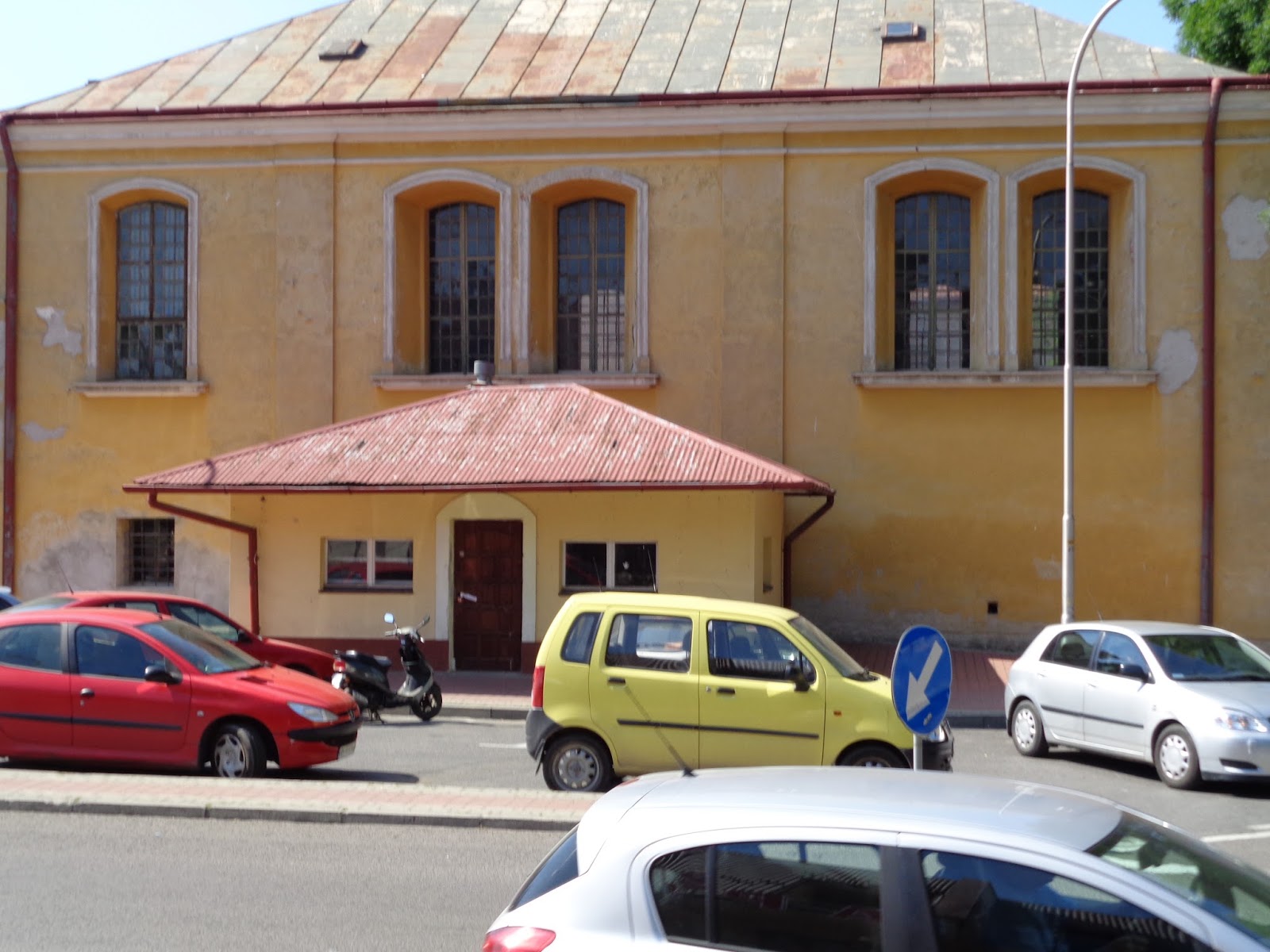
What there wasn't, was anything made of wood.  No pews; just a concrete floor, if I remember correctly.  The story goes (see plaque) that when the Nazis set fire to the synagogue, Count Alfred Potocki, in residence next door, appealed to the conquering thugs and got permission to let the fire brigade put it out.  So the building itself was saved.  From the outside, it's a quite nondescript yellow building, except for the signs and plaques on the door and the exterior staircase for women. 


I wondered if my grandmother had ever seen the inside of this shul; Lancut had been over 40% Jewish once and Przeworsk was a stop or at most two down the train line. Today we were clearly visiting a pilgrimage site; a place where the nearest living Jews were hours away, in Krakow, except for a Chasidic Brigadoon I didn't want to visit. Here in Lancut too, the Jewish cemeteries were walls and weeds. New pews might bring in destination bar mitzvahs. A start? 

When we were done we had some ice cream in the store across the street.  There was a cross on the wall behind the counter and a semi-scowl on the face of the woman who made the cones.  Maybe I imagined the scowl.  We walked back through the edge of the park, and picked up the bus back to Rzeszow.
The view from the ice cream place.