Translate

Showing posts with label roots trip. Show all posts

Wednesday, November 4, 2015

Roots Tour, Part XI, Leaving Grandma's Galician Poland, coming to Warsaw


 It's now five months since we made my roots trip to Galician Poland; I must finish my account before I have to rely entirely on photos and notes.

Still in Tarnow that Wednesday, we found a sign that said Rzeszow, near where we'd parked the car. So instead of retracing our route, we followed its arrow,  driving east on a smaller road  parallel to the A4 highway we'd come on. With the sun setting behind us, the hills brightly lit green, we passed Dembica, the ancestral home of the Jewish half of the family of my friend Pat, who grew up on Long Island.


Old Rzeszow hands by now, we made no wrong turns, pulling into the Hotel Bristol's underground garage just as night fell. We took a last walk around Rzeszow's cobbled rynek, full of echoing chatter from around the outdoor restaurant tables. In the tourist office, under the rynek one floor below ground level, a roomful of townspeople were taking dance lessons. I asked a young woman who was also watching the class from above if she spoke English and if she was local.  She did speak English but she was from Warsaw, here on business.  I explained that I was visiting my grandmother's ancestral area and she said that yes, many people from America were visiting now.  She didn't say Jews, but I'm sure that's what she meant.

On the other hand, when the tourist office had been open to the public during the day, and someone who was obviously a working student was behind the counter, I casually mentioned that we were particularly interested in remnants of Jewish presence, and it didn't elicit any unease at all. She told me about Jewish lectures and events in Rzeszow that we could no longer attend; our regular guided tour was starting in Warsaw the following evening. (Rzeszow's underground tourism office was also the entry point to the town's historic underground storerooms, which tunneled together, far around under the plaza. Had we had more time...)

The next morning, we drove our rental car with the schizo GPS to the airport, stopping at a gas station to top up en route, just like we do in Florida.  We couldn't figure out how to open the gas cap, and neither could the nice young man who worked there.  An anxious, wordless comedy ensued, with us searching the dashboard and the floor around the driver's seat while the time cushion before our flight ran out.  Finally, he motioned for our key; it was remote controlled. An age, not a language gap.


We thanked him, parked the car in front of Rzeszow's airport, dropped the keys at the counter, and  hopped the ridiculously cheap flight to Warsaw. We were probably the only foreigners in that little plane, flying over the green-blanketed landscape with the houses nestled in the creases.

Warsaw's Chopin Airport looked new and world-class. It was also cosmopolitan enough for a Chasid to walk through without looking particularly self-conscious, if they ever do. We hopped a cab to the Radisson, where our guided tour would begin at a welcome dinner.  After leaving our bags with the concierge -- it was still only late morning --  our first destination was the Emanuel Ringelblum Jewish Historical Institute, to meet Anna Przybyszewska, the researcher I'd met over the web, the one who'd helped me discover some new surviving distant relatives.

We were half an hour late, we thought, but we'd sent a message through to her that we would be.  We strode off from the hotel briskly, passing a synagogue and through a courtyard with Yiddish written on the exterior walls.  My husband had picked this direction, so I was pretty irritated with him 15 minutes later when we figured out we'd struck out in the wrong direction. We had to retrace our steps and be even later; by the time I got to the JHI, I was pretty flushed and edgy. 

Anna's office was shared with two others in a library room just off the main floor lobby of this historically Jewish, rare surviving building.  We walked in and introduced ourselves, and it turned out she'd been expecting us hours before.  A pale, slender woman, perhaps 50, with straight light hair that framed her face.  A delicate librarian look, but a piercing gaze.

 I really didn't have anything prepared to say or work on; the moment was too fraught, somehow. And anything on a screen can be done long-distance.  But my husband started talking with her at length, making me more edgy still.  Finally I blurted out, "Are you going to take all my time with her, too?"

Anna was a little appalled at this outburst. She looked at me rather sternly.  "These stories are important," she said.  "We have to hear this, too." I don't remember what the subject of their conversation had been, exactly; I just felt ashamed.  And by this Polish researcher, who had made it her mission to gather every possible detail about my murdered people.

Obviously, this work could have occupied far more people. It looked pretty wearing on her, and was not about catering to the impatience of any particular Jewish visitor, even if that impatience had 
been directed at a husband, and not at her.

We didn't make much more of the visit.  I had basically just wanted to say hello, and find out what would be involved in trying to track down distant relatives in Israel, the last evidence for which dated to the fifties. She quickly brought up our email correspondence and all the other material relating to my relatives that she had sent me.

The only other thing I remember her saying was that one had to be careful in teaching kids about the Holocaust, and not to overwhelm them with too much information at once; it could cause psychological harm.  It had to be appropriate to one's age and resistance to despair.  We left and another couple took our place.  Other people were sitting with her Israeli assistant, and the third worker.  Each specialized in different languages relevant to the documents they retrieved, were brought, and searched through.

My husband went to look over the historical exhibits on the upper floors, which dealt with the surviving ten percent of Polish Jews; the attempts at resettling and restoring the mental health of traumatized orphans (many understandably wanted absolutely no part of being Jewish), the role of surviving and survivor Jewish organizations. 


While he did that I went next door to visit Helise Lieberman, the executive director of the foundation for Jewish Life in Poland.   Helise for 20 years has been nourishing the seedlings of Jewish community in Poland with her energy, humanism, positivity and humor.  We too had been corresponding for months before my trip. She gave me a hug and she updated me on the people we had had in common; some dating to 1970, others, Yiddishists in 2015. 

Helise has represented the vestigial and replanted Jewish community to Polish prime ministers and visiting Americans for years now. She can be seen at all commemorative and holiday events, and was among those getting the enormous Polin museum project off the ground over the past decade.


Sunday, September 20, 2015

Tarnow, Part 2, Roots Tour, Part X

We would have liked to have met up with other Jews and Jew-lovers at the concert at the Bima in Tarnow that evening; we could have shared both the ghosts and living presence.  But my husband wasn't inclined to drive in a strange country with a schizo GPS in the dark.  So instead, we proceeded along the proscribed Jewish heritage path on the map given us at the information centre on the rynek, to leave before nightfall.  This led us to the remnant of the city walls, which we could stand upon.  And past that, to a monument to the first Transport to Auschwitz. 

This tells the story of the first transport to Auschwitz;
it came from Tarnow and it was 738 political prisoners.
Monument to first transport to Auschwitz, Tarnow
There were posters to this fact plastered around Tarnow's rynek; the first transport to Auschwitz was not a Jewish one. This transport was of 708 non-Jewish Poles and 20 Jews; they were sent in June 1940 as political prisoners, and the square from which they were taken was marked with a modernistic, minimalist art work.  The wide marble panel represented outlines of people rounded up from everyday worklives, holding briefcases, led by outlined soldiers in identifiably German helmets, jodhpur pants, with rifles slung over their shoulders. A couple of police were stationed there; a Polish flag waved on its pole. 
The former mikveh of Tarnow.  It must have been beautiful once.
Opposite this monument was a building with perhaps Persian-style keyhole windows and ornamentation; it had been the local mikveh.  Now it housed a restaurant, a salon and some other offices. Air conditioning units poked through the keyhole windows, indifferent to restoration.


Further along the route we came upon three posted sheets with the timeline of the destruction of Tarnow's Jews -- half of the population, or around 25,000 people.  Unlike something you'd read in America, this plaque showed the difference made by local familiarity; it named the who, what, where and when of each Aktion, day by day.  It named names, dates, times of day. 

This "Chronology of Tragedy" noted that the Germans first bombed Tarnow on Sept. 3, 1939 and took over the city five days later. They immediately started capturing Jewish men on the streets, confiscating their property and sending them off to forced labor camps. In November of that year the synagogues were torched.  The first 1940 transport of political prisoners to Auschwitz were tatooed with the numbers 31 to 758.

The Tarnow ghetto was formally established in March 1941; it was eventually stuffed with 40,000 Jews from the city and surrounding towns.  The first Aktion was in June, ordered by Obergruppenfuhrer F.W. Kruger.   Paul Reiss, head of Tarnow's Judenrat, was shot and killed on the spot when he refused to hand over lists of Jews marked for transport.

 "Due to the enormous task pose by the first Aktion, the security services sought assistance from the local and district police, a company of Waffen SS, headed by SS Hauptsturmfuhrer Klienow, stationed at Debica training Camp, the Sonderdienst (Special Services), the Baudienst (Polish Pioneer Service), and several employees of the Tarnow Labor Exchange."  My friend Pat's grandparents were from Debica, which we passed on our way back to Rzeszow.

"On the morning of June 11, after a speech by Klee, commander of the criminal police, the SS men were issued rations of alcohol and they and the Baudienst, armed with axes, broke down the locked doors of the Jewish houses."  The description that followed, of this and three or four more Aktions,  were obviously eye-witness accounts of mass murder and deportation to the Belzec death camp.  The final liquidation of the Ghetto was the work of Amnon Goth, who had proven his capacity for brutality in the ghettos of Krakow, Przemysl, Rzeszow, Lublin, and other towns. He was played by Ralph Fiennes in Schindler's List.

This Chronology of Tragedy was posted on that wall only in English; so for the benefit of Jewish tourists. Would the Polish version have remained unmolested on that wall? 

Krakowska Street, leading to Tarnow's Rynek
On our way back to the car we walked down Krakowska, looking for the address of my grandmother's cousin Chaim's tailor shop.  49 and 53 looked original, but 51 was obviously a post-war building.  We found another historical plaque on 53, with pictures of the occupation 1939-45.  We also had dinner in a very nice place called Tatrzanska. And we passed a huge red brick church, rose petals strewn all over the sidewalk in front.  A banner on one side of the door featured Jesus; on the other, Pope John Paul. Children stood near a side entrance in First Communion robes, a costume I recognized from Catholic Queens.  We also passed a large billboard, also featuring the Polish Pope, urging the congregation to take part in an upcoming group trip to the Holy Land.

Tarnow is named after this guy, I think.
I used to know more about him. Nobility?
We found a sign that said "Rzeszow" pointing out of the city, so we took the long way home, on a lesser road, as the sun set. Found our way into the hotel basement parking, from behind the rynek.

Thursday, July 23, 2015

Roots Tour in Galicia, Part VII: In which we find the one person in Przeworsk who could find a piece of proof


The three of us, led by Jakub, went into Przeworsk's Ratusz/town hall to look for records, as municipalities are supposed to hold those that are  less than one hundred years old. Older than that, and they go into regional Polish archives in bigger cities; in Przeworsk's case, Przemysl. 

The entrance to the Ratusz was now in the back, in a new addition whose construction was photographed the day Google came by in 2013.


Now it was finished and little kids played by the fountain.


We came to an office occupied by two women in their sixties; John Paul II's picture was on the wall.  Jakub explained the reason for our visit and they explained back, through him, that they couldn't help us; only marriage records were kept there.  We wanted another municipal office, they said; the one by the elephants. 

Elephants?  Were they pulling our leg?  We walked to Jakub's car, looking for elephants on signs or in store windows, then went a few blocks west on E40 until we came upon a pair of elephants on the road's grassy median. They were topiaries.  Cute green elephants, made of hedges, with red carpet saddles. And across the street from them was another office building, at the end of a flowery walkway, showing  Przework's by now familiar coat of arms, with the star and crescent.


Actually, I think there's something between Poles and elephants. They're a motif I saw painted on baroque  buildings in Tarnow and elsewhere.

Anyway, we entered this municipal building, whose halls looked just like town halls anywhere, with signs boosting  Przeworsk and everything that happens there, culturally, athletically, educationally, commercially.  We were directed up the stairs to another, smaller office, where two younger women, sitting at keyboards, also listened to our quest via Jakub. 
 
They were very sorry, but Przeworsk was no longer holding any town records; everything, recent to ancient, was now stored in Przemysl. Disappointing, but Przemysl was on our itinerary that day, anyway.  I saw a map of Przeworsk on the wall, the kind framed with squares of local advertising, and asked them if they had any more copies.  They apologized again.  We thanked them and went back down the stairs. 

Before we reached the first floor, the women called down after us and gave us the map from the wall, rolled up; a consolation prize.  I now have a nice map of Przeworsk and immediate vicinity, with the ads of many local businesses, mostly in home improvement, all around it.

Suzanne Wertheim's web page on Przeworsk had mentioned a local teacher, a Mr. Thomas, who had helped her identify old sites from pictures.  Jakub thought of inquiring in Przeworsk's public  library -- also conveniently located near the elephants.  I sat down at a PC and launched the familiar refrain of a Windows boot-up while he went to  ask the local librarians if they knew of this teacher.  Again, no luck.  And not much English, not even from the young civil servants. Sympathetic  smiles, at least. And Windows, in Polish.

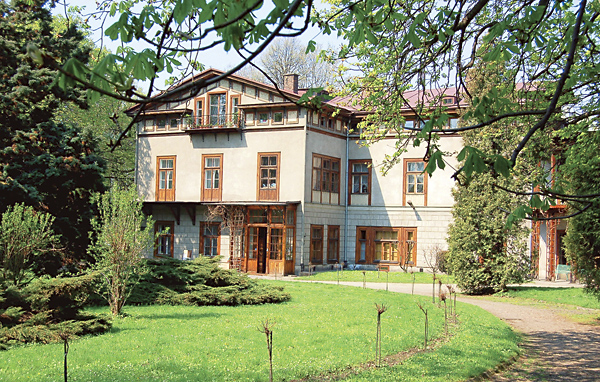
We were about to set out for Przemysl, the town after Jaroslaw, when I remembered that I'd seen a Przeworsk museum on the web.  That too, was nearby, in a park that had been another Lubomirski estate.   The museum itself looked like an old elegant country house.

I wasn't sure why I thought of the museum; I wasn't much interested in the case of surviving Judaica mentioned on their site; I know what menorahs and tefillin look like. Nor did we want to see any more aristocratic interiors, or the historical  firefighting exhibit. Again, another entrance, another explanation in the native language. 

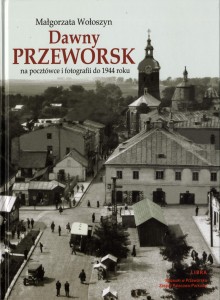
But this time we stirred up some enthusiasm.  Wait, let us get the local historian, they said. Turns out she worked upstairs.  Here, look at these books, in this case.  Here's a book of photos on the history of Przeworsk with a lot on the Jewish community, edited by this same historian. 

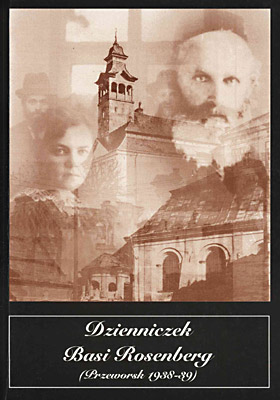
Here's another book; a diary, by the Anne Frank of Przeworsk, one Basia Rosenberg.  Well of course I bought that, and for only 8 zlotys.  Yes, it's in Polish.  I'm working on it. 

I would have been delighted to buy the book of photos, too, if that hadn't been their last copy. One of only 1000 or so printed,  it was out of print.  I'll be looking for it on Polish ebay.  We were ushered up the stairs to meet the historian, a woman somewhere near 40, I think, by the name of Malgorzata  (Margaret) Woloszyn.  She and a colleague were working on computers  in a cramped paneled room, and when we greeted her and explained our mission, she went into a back room and came back barely minutes later with some 95--to-100-year-old books of handwritten census records.

One book was an index to the others. And there, in those old lined but still sturdy pages, Margaret turned the pages to Schopfs and Schillers.  Including my grandmother, and her sisters, and brothers, and many cousins I never knew about, their birth dates, names and relation to their households, and the occupations of the head of the household, which was Krawic, or kravitz. This means tailor, which matched what I already knew.


We were all very happy, finder, researcher, interpreter/guide and husband. Here was proof, still in Przeworsk, that my grandmother, and therefore I and my family, had some connection to this town. 
 I asked her if she got visits like this much, from roots seekers, and she said that yes, she gets a few every year.

I was so excited that I took a lot of blurry pictures of the pages, and accidentally used the flash twice in spite of promising not to.  Some are sharp.  At least one page I'd like to ask her to reshoot and send me.

And I can, because I asked for her email address and she gave it to me.  I gave her my card and she stapled it into some kind of guest register.   And as soon as I finish this series -- or maybe even this post -- I'm going to write her, and Google Translate will do the rest.


The fact is that millions of birth, death, military and marriage records of Polish Jews are now searchable on the web.  I've found many and expect to find more. The Mormons gave Poland lots of money and resources to digitize all these records, in their dubious but indirectly useful effort to posthumously baptize everyone who ever lived.  So it doesn't really pay to spend too much of a short in-person visit in dusty archives.  Ms. Woloszyn herself said that these census books were going to be digitized as well. But there's still a satisfaction in seeing and smelling pages in ink and paper, in a tangible ledger, in seeing the names in that elegant turn-of-the-century penmanship. In being in the same general place where they were written, so long ago.

Now here's a really strange thing: The historian's last name, Woloszyn, is the last name of some of my husband's cousins. Bruce Wolosin, his third cousin originally from Cleveland, today lives in the same town we do and he and his wife are active members of my synagogue. Volozhin is a town once famous for its rabbinic learning. 

I'm sure this helpful historian isn't Jewish.   Jesus' picture hangs on her office wall, too.  But maybe, if you do some research...


Wednesday, July 22, 2015

Roots Tour in Galicia Part VI -- To Przeworsk's Market Square/Rynek and Esther's address

We proceeded by car from the Przeworsk bus station to the rynek, a few blocks away.  Jakub left to find parking while I looked around. The market square, where a hundred years ago peasants had come to sell produce and buy goods from (I'm assuming) mostly Jewish merchants, was also a park now.  It had nice plantings and paths and benches, a historical plaque, and the second incarnation of a statue 

commemorating the 550th anniversary of the Battle of Grunwald against Germans.  The first incarnation having been destroyed by the Germans in 1940, and the second having been erected, with an updated plaque beneath, twenty years later.  (See Hitler referenced in the Polish plaque.)

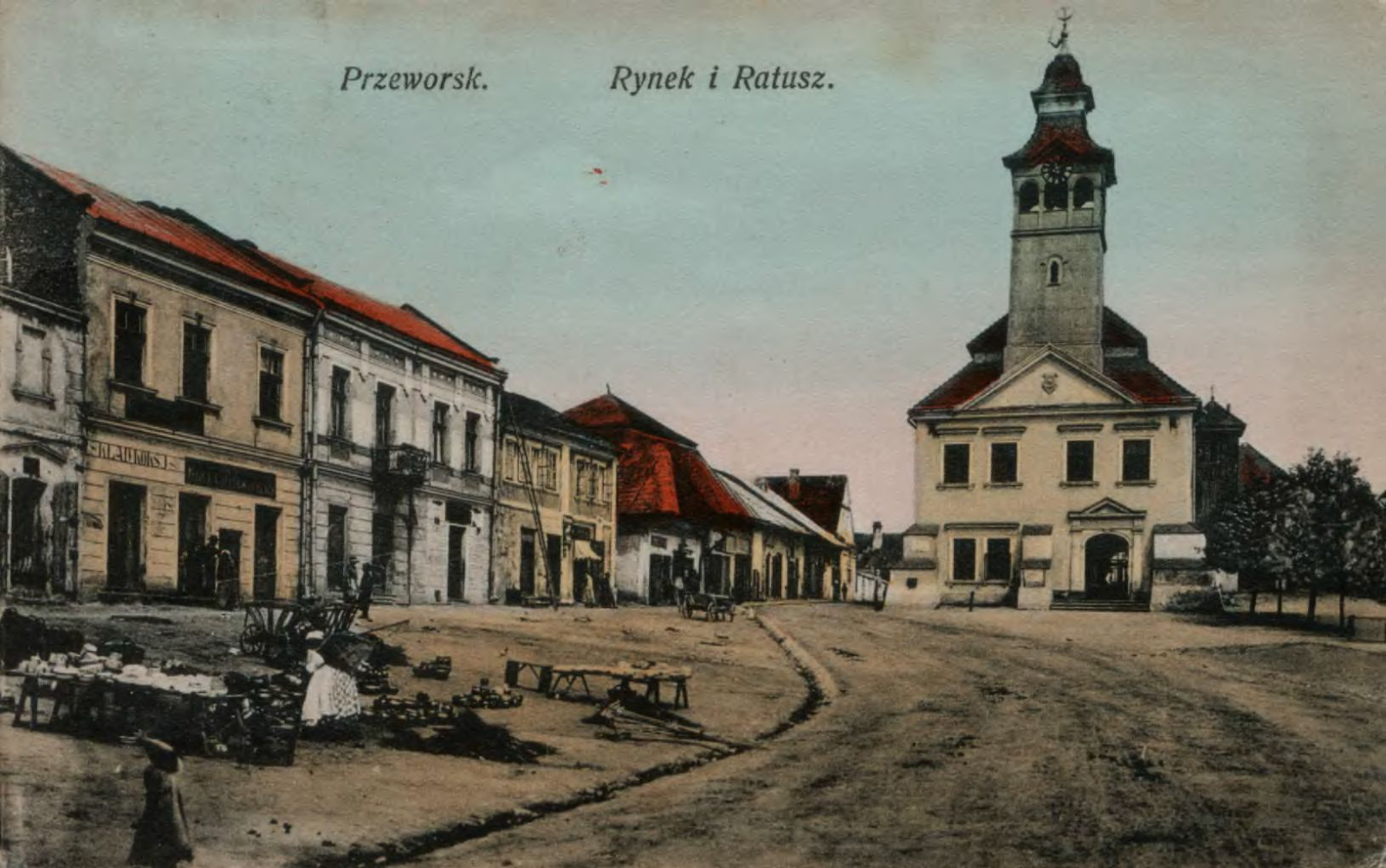
Older people on the rynek sat and chatted, or traversed it, carrying groceries (I'm assuming) home in plastic bags.  The town hall -- the Ratusz -- that I'd seen on old postcards on the web looked freshly refurbished, and most of its front converted into a restaurant.


I walked around snapping pictures, and don't exactly recall what expression if any I noticed on the faces of the people around me.  Nobody else was carrying a camera; Przeworsk is not a tourist destination.  I may have imagined them looking at me in a hostile way; I may have imagined they were those older, more rural Poles, some of whom may have believed that Hitler did them at least one favor, or who may have feared I was snooping around in search of a lost inheritance.


But my grandmother always described her family's situation in Poland as poor.  She would probably have been one part excited to five parts appalled  to know I was ever setting foot in Poland.  I should have taken way more pictures. But it's all there, all available in Google Street View.


The retail buildings surrounding the square looked freshly painted in bright pastels, and some had smaller-town versions of the ornate reliefs you see in European cities.  One had 1912 written under its pediment; my grandmother must have known that one and the ones near it.  And she must have known the Ratusz, with its Przeworsk insignia. Which includes a crescent; some nod to Turkish invaders or Tartars, I think.


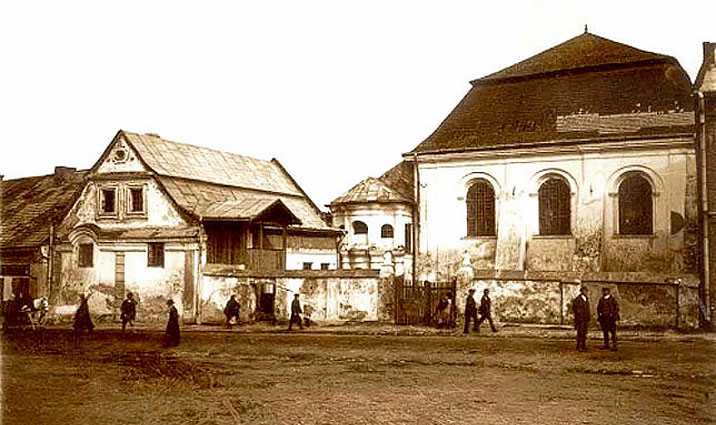
Unlike Jaroslaw ("Yaroslav") and Przemysl ("Pshemish") nearby, Przeworsk has no converted former synagogue to visit. Right off the rynek, peeking behind the Ratusz in some old pictures, it was destroyed.  You can find old black-and-white photos of it by googling Przeworsk synagogue, and Jakub determined that its former location was right on my grandmother's street, Kazimierzkowa. 


If you go on Polish ebay (www.ebay.pl) and search on Przeworsk, as I did just recently, you will find that someone in Germany is selling a rare and jarring photo of its destruction.  (Something from Opa's or great-Grandpa's old cigar box? safe deposit box?)


Jakub, my husband and I walked off the square in the direction of my grandmother's street; on the way we passed an old brick two-story building whose painted door baked in the morning sun; there was an  empty slanted groove in its doorpost, where a mezuzah had been. 


 If you don't count today's vigorous attempts at recreating Jewish community in Krakow and Warsaw, that empty space could stand for the Jewish mark on Poland today; an empty, Jew-shaped space.  You can find these indented spaces all over old doorways, and people do look.  Sometimes they're plastered over but still visible. (In fact, "Mezuzah" is the name of a group dedicated to restoring Jewish places in Poland.) This door's groove was so clear and easy to find that it was clearly deliberately left there for the occasional Jew or curious Pole to find.  And it was on a street perpendicular to Kazimierzkowa.

Now, pictures taken as recently 2005, taken by one Suzanne Wertheim,  show the old, single-story  wooden Jewish houses of Kazimierzkowa street, lopsided and low-roofed, but freshly white-washed and judging by the plants in the windows, inhabited.  One Polish site that shows them refers to them as "charming cottages." But we saw no sign of them on Kazimierszkowa in June 2015.


We couldn't find where 68 Kazimierszkowa Street, mentioned on my uncle's immigration ship manifest, might have been.  The buildings we saw -- mostly two- or three-story apartment houses and one-story businesses -- didn't number that high.  Short story,  the street was totally transformed.  There were no ancient people conveniently available to ask if they'd ever known the Schopfs.  It was just too far back in time. 

  
A young man came out of a store, but when Jakub asked him, he didn't know where 68 might have been, either.  There was a playground at one end of the street and another little park across the street. Behind the grassy strip, tall trees, and past the trees, the backs of charming, more recently built homes with lovely gardens, facing the next street.

We walked back to the rynek and to the Ratusz (town hall), to look for paper records of my family's existence.  According to JewishGen.org and other genealogy sources, all records less than a hundred years old were kept in the local municipalities.

Now that I'm home again, virtually retracing my steps, I see where I should have gone -- to the street that picks up across the intersection, changing its name to Jana KiliÅ„skiego. Here, back  on Google Street View, I see one-story homes that recall the shape and size, if not the facing, of the old, wooden Jewish homes in the old b&w pictures.  And  on that street, an actual original wooden cottage, still occupied when photographed in 2013. 


Sigh...  I did cross that street, but if I'd only walked a few more yards. Perhaps back in 1930,  Kazimierskowa had extended further back, in that Jewish loop of Kazimierskowa, KiliÅ„skiego and Bernardynska, east of the Ratusz/town hall.


Sunday, July 19, 2015

Roots Tour in Galicia -- Part V -- Przeworsk's Bus Station

The trip from Rzeszow to Przeworsk couldn't have been any more than forty five minutes, rynek to rynek (market square to market square). We were mostly on the same road the bus had taken to Count Potocki's Castle in Lancut, plus another ten minutes or so further east.  The weather was fine. Bennett and I peppered Jakub with questions all the way, about Poles and Jews today, about the shift in education after the fall of the Soviet Union, about his family, his girlfriend, his girlfriend's parents, his story, his current job, the masses of Hasidim he guides to former synagogues, other roots-seekers.

He stopped at the first sign marking the town.  Just a regular white-on-green sign, Przeworsk; just like Route 3 to  Passaic, NJ.  No grand lump rose in my throat.  I snapped the picture from the car.  It was just what I had expected, and the sign was so clearly of another Przeworsk, of another time, one where schools and restaurants and campgrounds meet you on the outskirts of a town so much bigger, more normal, better fed, and safer than the one my grandmother knew.  And of course, Judenrein.  Empty of Jews, who had once been up to 40% of Przeworsk.

The countryside was very pretty; lush green and mostly flat, with the Carpathian hills off in the southern distance.  In fact, the tourist brochures call this the SubCarpathian region.  It looked to me like flatter parts of upstate New York, with the same trees, the same wildflowers and tall grass, the same rolls of hay on open fields.  No wonder the Catskills looked so inviting.

Jakub took us first to the place where the maps indicate the former presence of a Jewish cemetery. Destroyed by Nazis, today it's the Przeworsk bus station, built during Soviet times.  I knew where to go before Jakub did, from many views on the web.  The little stone monument off in a grassy corner looked more worn up close. 


And the Polish inscription -- "Jewish Memorial" -- was barely legible, even to Poles, and the words below that even more ground down.  I knelt down to touch its crumbly surface, wondering which and how many ancestors' bones lay under the asphalt and concrete.

People sitting on benches, waiting for buses, didn't pay any attention to me that I could see.  Someone with a camera and perhaps a Jewish face, taking pictures and leaving pebbles must have been a sight they saw from time to time, maybe even with increasing frequency.  Somebody had already left pebbles on top; someone else had left a tinned yahrtseit candle, and someone else one of those reddish candle lamps you see at other Polish gravesites and monuments. The little monument was shaded by a few trees.

 It was a run-down bus station, at that, with skimpy shelters that didn't shade very well, and benches and railings in need of fresh paint.  Polish web sites (thanks again, Google)  report that plans to renovate the station have been hampered by the chief rabbi of Poland, who will not give permission to do any more violence to a Jewish burial site.   Nowadays this is a consideration.  Could they move the bus station?  It's right alongside the main road, choked with traffic. 

Again, it was hard to connect the physical place I saw, heard and smelled with the emotional place I had contemplated remotely.  Maybe the more Zen could wait for something to connect in the head.  We had more places to see.

Across the street from the bus station is a triangle-shaped park that probably covers some of the cemetery, too. We saw other places, like Rzeszow, where that was the case. And on that triangle I got a better look at the huge crucifix I had also seen via Google Street View.  This, too, I learned to my surprise, had been erected under Communist rule.  But I'm not sure anymore.  Because what I saw up close was a tall three-part column commemorating Poland, or more probably Polish war heroes, with eagles.

The huge crucifix was bolted onto one side of that column.  Perhaps an addendum, a retrofit, or possibly even a retort, to that original secular, military monument. 

And at the foot of it all, a huge inverted stone pyramid with an inscription in honor of Pope John Paul II.

The naming of a Polish pope in 1978 is a point of national pride still sharp today, and if I understand the words for "Millennial Year," in the middle of his papacy, in 2000.  Typing the words into Google Translate gives me what is probably a quote from that pope: "Open the doors to Christ, victims of fights for freedom and human dignity."

Perhaps all expressions of Catholicism were a defiant gesture at Russia, once the Iron Curtain fell.  Because today and maybe since forever, Polishness seems to have been inextricably bound up with the Catholic Church.  It was an institution the Russians knew better than to try to mess with. In contrast with a secularizing western Europe, Poland, we're told, is 97% Catholic and 70% observant. A principal export is priests. And unsurprisingly, this is especially true in small towns like Przeworsk.

Certainly nobody had to ask any rabbi's permission when they erected that crucifix, staring out over what they surely knew, and still know, was the Jewish cemetery. 

Sunday, July 12, 2015

Roots Tour in Galicia -- Part IV -- in which we prepare to set off for Przeworsk


Our third day in Poland, with our jet lag over and our bearings set, we visited my grandmother's ancestral town, Przeworsk.  For this we needed an actual guide; someone who could talk to locals in native-fluent Polish, someone familiar with the context of my trip, the lay of the land, and where to find parking.  I found such a person through the Emanuel Ringelblum Jewish Historical Institute in Warsaw.

I had googled my way to the JHI; it occupies  the same geographical footprint as the once (as you can tell from old black and white photographs) Great Synagogue of Warsaw on Tlomackie street, blown up with official German fanfare in 1943, right after the ghetto's liquidation. Today it's a blue Met Life skyscraper, towering over north-south tram lines.  Right next to it is the associated Jewish Genealogy & Family Heritage Center, which occupies the related building that survived; it had been the grand shul's library and appears in those same black-and-white photographs, looking just the same, from the outside, as it does today.  


Both institutions are named after Emanuel Ringelblum because he, doomed to die in the Warsaw Ghetto, succeeded in preserving the history of that mass murder by starvation and final liquidation.  He and his fellow witnesses buried thousands of documents under wrecked ghetto buildings in metal boxes and three Tevye-style milk cans. One set was found in 1946; another in 1950; a third has never been found. A lot of the quotes appearing in the Holocaust section of the new Polin Museum come from that Ringelblum Archive.

But I didn't remember about Ringelblum till later. Still home and planning my trip, what I saw on the JHI's web site gave me a shiver of recognition. The executive director pictured there, Yale Reisner,  was someone I had known 45 years before; we had shared a seven-week USY teen tour of Israel in 1970.  He had been the younger son of the Philadelphia rabbi-and-wife couple who had led that trip.  I had become good friends with his older sister, and remembered him as a friendly younger brother.  I also had visited Rabbi and Connie Reisner and their kids after the trip, in Philly, and when they moved to Bersheva, the year I lived there after college. Yale had been living in Warsaw for the past 20 years or so.  That is how small the Jewish world is, or at least the part interested in history and genealogy.

But the JHI web site was somewhat out of date. Today Helise Lieberman heads the organization.  I contacted her via email; we played master-level Jewish geography, we became Facebook friends, and on a visit to Bersheva that she was making just after I'd introduced myself, she remembered me to Yale's family, who did remember me.  Fate was coming along on my trip.

Helise hooked me up with Anna Przybyszewska, the associate director of the genealogy center. Anna took the information I'd been able to glean over the years at Jewishgen.org, Yad VaShem and ancestry.com, and improved upon it quite a bit with research in Geni (another genealogical site), archives in Polish, and others not available to the general public.  For example, she drew me a family tree that started from my grandmother Esther's grandparents, which revealed a couple more second- and third-cousin survivors living in Israel as well as lost distant cousins.  One of the newly discovered survivors had drawn a whole list of lost family members himself, with their fates, for Yad VaShem. Those survivors' documents and addresses dated all the way back to the fifties, however, so finding these people's descendants  may take quite a bit more effort, assuming they're interested. 

Anna P. also found documents created in the wake of the war, by the organization responsible for relocating and reuniting Jewish survivors -- the Centralnego Komitetu Zydow w Polsce, or Central Committee of Polish Jews.  These documented the survival of people we knew. One was my mother's first cousin Memel, born in Przemysl and hidden with his parents ("on the Aryan side," the document says). But Memel's father -- my grandmother's brother Meyer -- disappeared  when, the story goes, he went out to find food.  The documents showed an address in Przemysl, half an hour east of  Przeworsk, where he and his mother had been living in June 1946, before they made their way to France and finally New York.  (Today Memel/Michael is a retired federal lawyer and grandfather of five living in Silver Springs.)

Anna also found us the address of the tailor shop of my grandmother's first cousin Chaim, in Tarnow,  90-100 minutes west of Przeworsk on the same highway.  And possible relatives, other murdered people named Schopf, in nearby Kanczuga and Lancut and other places.

Jakub and Me
Helise also found me my guide, Jakub Lysiak. A 32-year-old Pole of Catholic origin, he spoke fluent English, Hebrew, some Yiddish, and had majored in Jewish Studies at Warsaw University. He had worked for the Israeli Consulate in Warsaw, in the new Polin museum, and lately was in near constant motion touring Jewish youth groups and people like me around Poland, Ukraine, Lithuania, Latvia, and back and forth to Israel.  We agreed to pay his fee for just the one critical day, and planned to hit three of the towns my grandmother used to mention; Przemysl and Jaroslaw in addition to Przeworsk.

Jakub met us in the lobby of the Hotel Bristol at eight that morning, in jacket, shirt and jeans. He drove a comfortable van, parked just off the Rynek.

All Jakub's clients, naturally, wanted to know the reason for his choice of career, and most suspected at least some Jewish ancestry. He could verify none.  His Jewish story, told while driving us east, started with an essay he wrote in high school for a nationwide competition started by Golda Tencer, today director of the Jewish Theater of Warsaw.   Jakub won first place. The prize was a trip to Israel.  He was also in the first group of exchange students in a Polish-Israeli exchange.  He had both an affinity for Jews and few illusions about the persistence of antiSemitism in Poland.  In some cases, he said, it was fear of contemporary Jews seeking ancestors' property, several generations after it had been stolen by Nazis and given to Poles at firesale prices or simply as rewards. But it was an attitude receding with each new generation. 

It was also useful to know, as we did from reading, how thoroughly the Poles also saw themselves as victims of Nazism.  They had lost three million of their own, as well as 20% of their clergy. (Just two weeks before we left on our trip, I had happened to be at the Holocaust Museum in Washington DC, where I was visiting my daughter. I saw a WW II-era film strip there of a couple, a Polish (non-Jewish!) man and a German woman, being paraded through town and officially humiliated for defiling the Aryan race with their illicit relationship. Of course, the extent of their punishment was having their heads shaved,being paraded with signs and perhaps public shunning. Nasty enough. But survivable. And on the third hand, a clear demonstration of how Poles were regarded by Germans. Plaques blaming "German Genociders" and destroyers are all over Poland.) 

We had been emailing back and forth for many weeks.  


Wednesday, July 1, 2015

Roots Trip to Galicia, Part II

Our room at the Hotel Bristol gave out on a great view of Rzeszow's rynek/old market square and the old town hall.  The strange thing about the room, aside from a total absence of closets or drawers, was the bathroom: The walls separating it from the rest of the room were simple glass.  And outside of this glass there were floor-to-ceiling curtains. Two days later I asked our guide, who came up to check out the place for his clients, if this was a Polish thing or just weird.  He said it was weird. So maybe just avoid Room 205, depending how much you value the view.  Either one.
View of Rzeszow's rynek from our window

Room 205 also had a nice big flat-panel TV on the wall,  desk, free wifi, mini-bar, coffee maker, hair dryer, iron and ironing board.  And on the beds, duvet covers with blankets inside.  My grandmother used to make her beds that way. I don't know where we got top and bottom sheets from: the British, maybe?  Thank you, Brits, because a) it takes some practice to insert blankets into duvet covers and b) they were too heavy, even in the oddly cool June weather,  forcing us to waste energy  on air conditioning.  Or it would have wasted energy, had we had any real control of the air conditioning.  We didn't;  although we had thermostats, we discovered that they rarely worked, in any of the six hotels we slept in between roots tripping and guided tour. So we finally just shook the blanket down to the bottom and slept under the cover.

After a nap, we started exploring our neighborhood, armed with a map from the hotel desk.  There were several little Jewish star icons on it, marking former synagogues, right near the square.  So after checking out the square a bit, and taking pictures with Kosciuszko, we went off in the direction of those Jewish landmarks. Go to Google street View, and search on 6 Boznicza, Rzeszow; it'll put you there, right near some theaters. 


Of the two former synagogues, the white building was now a town archive, and a notice at the door advertised some workshops or lectures on Jewish history, given in the mornings.  I don't know what the other, pink-and-tan one was now; it was marked with a small mogen dovid and other plaques, in Polish and satisfyingly imperfect English.  These were home-made, if not home-funded memorials.  

Here's the view around the corner of the pink building
These are the plaques on either side of the front door.
This one, clearly older, is in Polish, German and English. 


There was no surviving Jewish insignia on the buildings themselves, which stood across the street from a park.   And in the near corner of that park -- if you just turn around in Google Street View you'll see it -- stood the first of many plaque-bearing stones we were to see, also with a Jewish star. 

The stone's plaque noted, in Polish and Hebrew, that this had been the site of a Jewish cemetery since the sixteenth century, and was therefore chosen by the Nazis as the "concentration point" i.e., the roundup point for Rzeszow's doomed Jews, in 1942.  This was the first of many somber and unsurprising monuments.  The only surprising thing might have been how recently that stone's marker had been put there.  We met one of the men responsible for mounting it there the following day.

In spite of our jet lag we schlepped ourselves perhaps a mile farther, past a hospital and other medical/therapeutical sites, through a rainbow-colored bridge over a small canal flanked by a bike path, to another marked site: a Jewish cemetery.  When we got there, we found high brick walls, plastered over; parts of that wall painted over, a tall iron gate, and through that locked gate, a partial view of a field of tall weeds. We knew the Nazis had destroyed most Jewish cemeteries, but Rzeszow's tourist mapmakers had put this one on its map anyway. I walked along the wall, seeing only old phone poles and their wires beyond and inside.  Perhaps there was an office in there once, perhaps it had a phone by 1942. Or maybe these were strung to other places, beyond the wall. There was another starred cemetery  further from our hotel; we skipped it.

In the same vicinity as the former synagogues, was "Ghetto Victims' Plaza," where this memorial stood.  In some places formerly Soviet-bloc countries allow a few Soviet-raised monuments to remain, acknowledging their role in liberating them from Nazi Germany.  


Back on the rynek we enjoyed a decent supper at an outdoor table, next to a table of young men speaking French.  The waiters gave the diners  blankets against the rare June chill.   

In checking some facts, I just came upon this site, which documents, with remarkably exact names and dates, the terrible fate of the Jewish third of Rzeszow, and the ghetto,which held Jews from around the area on their way to Treblinka, Auschwitz and mass graves in forests.


 Galician Jews had their own name for Rzeszow: "Reishe."

The shiny little airport we landed in, just north of the city, was probably once the military airport where slave laborers were sent during the war.