Translate

Showing posts with label Yiddish. Show all posts

Sunday, December 8, 2013

The Weekend Not in Scotland, Part III


I've already posted two installments of the not-in-Scotland October weekend without describing the trip's core mission:  attending the "Community Open House" of the National Yiddish Book Center, following a postcard invitation and the cancellation of our Scotland plans.   Aplologies.  Over six or seven weeks, this task has languished, stopping up the flow of at least four potential posts. 

The main room of extra copies of rescued
Yiddish books at the Center -- waiting for homes
Anyway, the Yiddish Book Center's mission -- propelling Yiddish into present and future generations -- is clear as a bell and visibly passionate, even before you cross its threshold in that apple orchard up in Amherst.  Before going through the front door, you cross a little bridge. The bridge is labelled "Brik."  Instantly I'm reminded of the song I learned so many years ago, "Dortn dortn," whose first line has the words, "ibern vasserl, ibern brik"; over the stream, over the bridge.  Here's a word to keep, before you even get inside.

I love this place for bringing all this Yiddish back to me from long-term storage.  The old books on the rows of shelves, extra copies waiting to be bought and read, are a perfect physical analog to the dormant vocabulary in my head waking up and getting exercised. And all brought back from a time I looked like the young romantics here, except perhaps for the purple hair.
Can you make out the "shrekliche" disaster 
reported on here? No peeking on the bottom!

While I've earned my special affinity by virtue of courses taken decades ago,  the Center also tries very hard to draw in those who don't speak the language a bit.  There are exhibits tucked in among the books; an exhibit of great Jewish moments in popular films and TV shows; front pages of the Yiddish press on historical news days, with translated headlines; old Yiddish linotype machines and their histories; stories behind the translations of great works; pictures and old home movies of an ethnomusicologist's travels through Eastern Europe.    There's also the huge original crate, pried opened with (replaced) books spilling out in a prominent place on the floor, which was sent from the evaporating Jewish community of Zimbabwe.

Who knew? 
There's a sandbox of sorts for playing with Yiddish; a table set with labeled objects and a Yiddish menu.  A phone with recorded phrases to converse with. There's also shelves of good Jewish picture books for children, in English, and comfortable space to read them in.

Exhibits educate the Yiddish deprived.
I love this place for transplanting Yiddish into progressive New England, a place whose trees and fields might resemble the Galicia of my grandparents, but whose sensibility is so modern and world-embracing.   As Yiddish was once, too. A language too rich to starve in ossified Hasidic enclaves, the only place it's natively spoken now.

Once inside, a Yiddish, entre-nous (tsvishn unz)  sense of humor permeates the place along with its eagerness to teach; one of the rest rooms is labeled Vu Der Kaiser Gait Alayn.*

Yiddishist-in-training giving a tour beside
the crate of books from Zimbabwe.
I spend time reading the spines and sometimes even the contents of the shelves, and read the posters and understand a good deal of the song sheets and film clips, even without the subtitles.

I love this place for  memorializing its poets and playwrights on slate squares, in Yiddish and English, over engravings of leaves, among the outside plantings.


The Writer's Garden
English-to-Yiddish is in the works


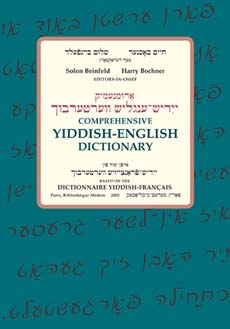
Beyond the main room of books, there's an auditorium where Dr. Harry Bochner and Professor  Solon Beinfeld, sixty- or seventy-something editors of the new Comprehensive Yiddish-to-English Dictionary, are being interviewed on stage by young Josh Lambert, academic director of the Yiddish Book Center and visiting English Professor at nearby U  Mass.  The dictionary, the first since Uriel Weinreich compiled his back in 1968, has just been published.  These philologists are describing how it differs from its predecessor.  For starters, it has 50 percent more words.  The editors got a great leg up on their project through the efforts of a new Yiddish-French dictionary, whose authors Yitskhok Niborski and Bernard Vaisbrot  created the large corpus of Yiddish words. They say it's also easier to use, without all the cryptic abbreviations.

This volume also includes words Weinreich simply didn't like; his dictionary is famous, for example, for leaving out the dirty words and even "tuchis," one of the best-remembered Yiddish words that ever lived.  It also includes words with the German-type spellings that were favored by socialists.  Adamant secularists, they didn't want speakers to have to refer back to their religious educations to know the original vowel-free spellings of Hebrew words, which keep their original forms when passing into Yiddish.

Linotype machine


The Forward newspaper put up some of the funding for the verterbuch, with the understanding that this lexicon would be used to help readers understand their Yiddish online edition. Some also came from the University of Indiana, whose press is the official publisher. 

The day proceeds with campus tours, including descent into the climate-controlled archive in the basement.  Oddly, they tell us that everything to be digitized is schlepped to Israel for this process and then schlepped back.  And Hebrew-character OCR and indexing, performed pro bono by Assaf Urieli, a computational linguist in the French Pyrenees, will ultimately render the Center's whole collection of books searchable online.

The day ends with a Q and A with Aaron Lansky in the bigger auditorium, followed by a great performance by klezmer duo Debbie Strauss on violin and accordion and Jeff Warschauer on guitar and mandolin. They don't do the Yiddish standards, but gems I've never heard before.
Aaron Lansky

On the way out I buy, for eight dollars apiece, part II of Sholem Aleichem's wonderful Motel, Peysi the Cantor's Son in the original, a Workmen's Circle Yiddish children's textbook from the sixties, and a book of poems in Yiddish and Hebrew. I also buy a copy of the dictionary, just to show support.  Did they know my Rutgers teacher, writer Wolf Younin?, I ask, while they sign the book. Dr. Bochner says he had heard of him.  Later that evening, in downtown Amherst, we bump into him with friends at Moti's, the local middle eastern restaurant. We try to cozy up, even peripherally, with the few families who constitute the Yiddish pillars of Boston. 


*    "Where the Kaiser goes alone." 


Monday, October 21, 2013

The Weekend Not in Scotland

So we were supposed to go to Scotland.  Why Scotland?  It's never been high on my bucket list.  What do I know from Scotland?  I like bagpipes.  I liked Brigadoon.  I liked Nova Scotia, which means "New Scotland," and where descendants of the original Scotsmen still play bagpipes. I like Pendleton wool plaid.


On the other hand, I hated Braveheart. And for sure, I have no use for Mel Gibson, although I imagine he has no real claim on Scotland.  No, the real reason we picked Scotland was that we wanted to go somewhere, we hadn't done any particular research or planning, and our daughter, who had been there not long before, said that Scotland was "magic."   Our neice, who had spent a semester at Edinburgh, was equally encouraging.  And I figured I had all these other years with which to check off places, at least the high ones, on my bucket list.

I'm a bit less sure about that last part now, because it turns out I didn't go to Scotland; instead, I developed a very painful knee a few weeks before the trip and hobbled around on crutches for a while, convinced I had torn cartiliage and needed arthoscopic surgery.  Turns out I probably don't need surgery now -- just NSAIDs and physical therapy -- but I cancelled the trip to Scotland.

Instead, as a consolation prize, we took up the invitation of a postcard we'd gotten just this past week, to the Community Open House of the National Yiddish Book Center in Amherst, Mass.  A mailing with so little notice that it couldn't possibly have drawn anyone from as far away as New Jersey, unless those people just happened to have cancelled other plans for that week.
Now the National Yiddish Book Center was a place on my bucket list, and cheaper to reach than most -- just about three and a half hours away by car.  So I fired up the old seach engine to find the nearest hotel with at least a couple stars that we could stay in for under $130.  It being peak foliage season, that turned out to be the Springfield Sheraton. That's where I'm blogging from tonight, after a beautiful autumn day at the center, which sits in an apple orchard next door to Hampshire College.

Built in 1997, I think, the architecture of the National Yiddish Book Center evokes the low wooden roof peaks of a shtetl.  But the sensibility, while thoroughly Jewish, is also thoroughly northeastern liberal artsy.  The interior is light and airy, the buildings that give an appearance of forming a village are really all interconnected, and the rescued Yiddish books -- the extra copies that you can buy -- sit in a huge library space with the light and colored banners and light-colored Danish modern woods and staircases that bring to mind the late-model children's science museums you take the kids to on vacation in New England.

For those who don't know, the National Yiddish Book Center is the brainchild and life's work of Aaron Lansky, who describes its founding in the wonderfully written Outwitting History.  Go. Get. Download. Read. It tells the story of a 23-year-old grad student who, upon realizing a serious shortage of Yiddish books with which to study for his advanced degree, puts out a call for local Jews to call him before dumping or abandoning their Yiddish libraries.  And how this leads to whole apartment buildings full of Jews entrusting to him the books their children cannot understand or appreciate, and how he has to sit down to a glass of tea, cake and conversation with most of them, and how it eventually leads to a network of dedicated collectors and the amassing of 12 times the Yiddish books that anyone thought were ever in existence, from NYC, and then from Boston, and eventually Buenos Aires, and Zimbabwe, and azoy vayter (etc.)

To avoid a) bringing his parents' house down under the weight of so many books and b) the infighting among Yiddishist academics that prevailed in New York City, Lansky eventually relocates his collecting enterprise to bucolic Amherst, where his undergrad alma mater, Hampshire College, sells him the apple orchard parcel of campus on which the center gets built.

Lansky, who I've tremendously enjoyed reading and also heard once or twice in person at NJ venues, has come to share this mission with a couple generations of new Yiddishists by now, as well as the older generations that sent him or called up his dedicated zamlers to give their books a home or rescue others  from dumpsters.  Steven Speilberg and others have donated the funds to digitize a large percentage of the works and make them available over the web, so that now anyone can make a page or a whole story of Sholem Aleichem or hundreds of other Yiddish writers come out of their very own printers, in Yiddish, on regular printer paper.  20 years ago, this took a trip to a specialized library, to borrow or just read there a book too old and delicate to subject to a copier glass.


But I'm getting ahead of myself.  I can make up for weeks of not blogging with this one goldene weekend, so I'm going to see if I can post this with my mouseless iPad before ikh gey shlufn, and save the rest for later.

Wednesday, July 3, 2013

Circle Lodge

We're going up to Circle Lodge tomorrow.  Here's something I wrote about the place two years ago, on a similar trip. 


           *                                              *                                              *

You can’t find Circle Lodge, the Dutchess County, NY resort established by the Workmen’s Circle in 1927, on Trip Advisor. I’ve tried and failed to add it there, in an attempt to forestall its imminent passage into American Jewish history.  

It would be a major mitzveh.  You only need enough people under 75 to find kindred spirits among the guests you meet there today – the children, grandchildren and great-grandchildren of the Arbeiter Ring’s Yiddishist, socialist founders.  With that fresh blood, the place could and should survive a bit longer, embracing a few more generations in its liberal, worldly Jewish literacy. 

They had a little fire in an air conditioning unit the last time
we were at Circle Lodge. We got to see some of Dutchess
County's Finest. Nobody was hurt. 
The food is great; you can gain just as much weight here as in the Catskills, which are on the other side of the Hudson and further north.  Come to think of it, Circle Lodge has outlived the Catskills that we non-Socialist Jews knew; those resorts all having closed or gone super-Orthodox.

Circle Lodge’s entertainment and cultural programming are secular Jewish, humanist and global in outlook. The lake is nice (once shared with a Jewish camp that leaned further left; they didn't speak to each other), the cottage rooms from another age but decently maintained, with screened in porches for reading and mah jongg.  And the guests, many 80-plus, are great role models: outgoing, intellectually active and curious, still sharing experiences and laughs over the table after careers spent as teachers, doctors, and other socially useful occupations.  The resort’s golf carts continually zip them from registration to cabin and up the hill to the dining hall and folk dances, movies, lectures and bridge games.

On our last two visits there, we were comped with a lakeside cabin; my husband came to give talks on topics of Jewish historical or linguistic interest.  This July about half that day’s guests attended, the rest having come for Bridge week. Yiddish Voch (Yiddish Week) is the biggest draw, a week devoted to Yiddish classes at all levels, literature and music.

The resort’s wooden buildings are large, decorated with murals and full of camp sports and cultural history, named for literary and historical greats and Workmen’s Circle luminaries known by previous generations.  The library, theater/social hall, gazebo, waterfront and one of the pools are shared with KinderRing, the children’s camp born out of the same secular Yiddish political and cultural outlook, also in 1927. 

This year I met Barnett Zumoff, 85, who had served as camp physician for over 50 years; the infirmary on the KinderRing side is named for him.  Today he’s still playing tennis and translating Yiddish poetry.  I also re-met Zisl Slepovitch, recently from Minsk and under 40.  Zisl has a Music PhD from Moscow, teaches at Brandeis and other places, speaks English, Yiddish, Russian, Ukrainian and Polish, and served as musical director of the latest show running in New York’s Folksbeine, the only surviving Yiddish theater in America.  

I’d first met him a month earlier, while riding Folksbeine’s float in the Salute to Israel parade down Fifth Avenue.  He was playing a mean klezmer clarinet.  I also met Helen Bloch Cooper, a pretty almost-90 actress on the Yiddish stage, who needed some help getting her email from one of the Circle Lodge computers, in the room next to the snack bar.  Most of the PC users are foreign KinderRing counselors, here for the summer, who Skype home to parents and friends.  After they sign off, the computers boot up with Cyrillic interfaces.  

An Irish-born counselor gamely tried to help Ms. Cooper get her AOL mail – she couldn’t remember her password – while she alternately showered him with thanks and apologies for her failing memory.  But the counselor wound up registering her to a whole new account, and she feared that all her messages were lost.  After he left, and with the help of AOL’s Indian tech support, I proved to her that her old account still lived.

Also at my table: two middle-aged women from Jackson Heights, Queens, who spoke Spanish and seemed a little self-conscious.  We got to chatting; one of them turned out to be the widow of a former Circle Lodge cook. She still thought it a fine place to spend a few days’ vacation, with trips to nearby Hyde Park (Franklin Delano Roosevelt’s family compound) and the Culinary Institute of America.  Also a couple, he 100, she 95, brought for the whole month of July by their 70-something daughter and son-in-law.  While the food is served buffet-style, the dining room staff served Max and his wife. Everyone, guests included, were eager to offer help he didn’t want. 

You also typically find a few Russian Jews.

This being a Yiddishist place, at least historically, the buffet room is decorated with posters of YiddiShpeil, the Israel-based Yiddish-language troupe. When I first came, over 10 years ago, program director Michal Baron  started our day at breakfast with a news summary in Yiddish. Michal and his wife are still working here, but this has been discontinued.  With a few holdouts, the fluent Yiddish speakers were today’s guests’ parents, grandparents and great-grandparents.  But the 80-somethings’ children, grandchildren and great-grandchildren come as well, many of them KinderRing alumni.

Since I married into the Jewish left, I have no history or relatives among the regulars at Circle Lodge. But I did study Yiddish, in college.  So I know something of the philosophy and enjoy striking up conversations and poking around, in the library and at the wall hangings. 


Tuesday, January 8, 2013

Yiddish Class: a Forshpeis


I taught my “one-shot Introduction to Yiddish” Sunday, billed as a “forshpeis” -- an appetizer.  13 people showed up, mostly friends from book club or the women’s Rosh Chodesh group or the Hebrew reading course I taught a couple times.  But there were also two new faces, including one of two whole men, allowing us to demonstrate that Yiddish, like other respectable European languages, has gendered verbs and nouns.

My Sholem Aleichem
Bobble Head Doll
Me teaching Yiddish is something of a chutzpeh; I took all of one year of Yiddish in college, all of thirty-something years ago. I’ve tried to keep it fresh since then with the occasional Sholem Aleichem story, song, conversation, class, or the occasional Folksbeine show on the upper west side.  But in my shul, this makes me resident mayven; me with my tattered/tserisseneh Uriel Weinreich College Yiddish text book and dictionary.  Maybe -- efsher -- there’s someone in the congregation who’s more fluent. But they don’t have my compulsion to do stand-up. Or they literally can’t stand up that long. In any case, it’s an easy, friendly audience and on Sunday we laughed and learned a lot.   

No classroom rows for my students and no textbook; they sat in a circle with their names written at their feet, so they could spend the two hours talking to each other, cultivating their seedling vocabularies.  I prepared sheets with a couple of verbs and phrases, pronouns, who-what-when and some nouns, using my old Hebrew word processor. DavkaWriter, circa Windows 95, conveniently includes a keyboard with the subtle Yiddish variations on the Alephbet:  the paired yuds that say “ay” (no line beneath) and “ei” (little flat line vowel beneath); the paired vovs that read as “v.”  Reclaim your Ashkenazic “aw” vowel -- the one modern Israeli Hebrew turned to “ah” -- change ayin from dumb silent letter to “e” as in egg, and you’re mostly good to go. 

Used only for reference -
but it's good.
Under my prodding, my students asked and told each other their names, what they did for a living, what they and others were or were not (mothers, fathers, aunts, daughters, sons, Jews, students, teachers, nurses, doctors). 

Also nudniks, goniffs, bubbes and zaydes.  That’s the fun thing about teaching Yiddish to over-fifties;  when they tickle the right neurons, even those who can’t read Hebrew letters -- even those who might not have grown up Jewish but merely lived near New York -- realize they have vestigial vocabulary to draw on; enough to recognize words and phrases I throw out without introduction or warning.  Those who haven’t been pretty little girls for 40 years remember “Shayne maydl.”  They remember being told to eat, my child; to go to sleep, to come here, to come home, by doting grandparents using little bits of Yiddish for extra sweetness or intimacy.

Then we have two students -- bright professional women, in their eighties and nineties -- who can actually take off in whole if imperfect, grammar-free sentences.  My Yiddish was artificially induced at Rutgers; theirs was born at home in Brooklyn. These two enjoy the class as much as anyone, hearing the language of their long-gone parents.  And we love to have them with us, reminding us how authentic the language can sound.  They thank me profusely and encourage us to continue with a course.  And most participants say they agree.  We’ll see…