Translate

Monday, August 28, 2017

Chautauqua, Part II: The password is Chicken Farm.

We knew that Chautauqua Institution's 's origins were Methodist. We also knew that Chautauqua Lake's far corner of upstate New York was way west of the old Jewish Catskills; far, even, from the more adventurous Adirondaks, where Ben and Jerry's has outposts in at least two towns. So far from our roots was Chautauqua that we heard about it from Connecticut Yankees, now related through marriage.  They assured us that there was a Jewish denominational house there, where maybe we could still book a place to stay. 
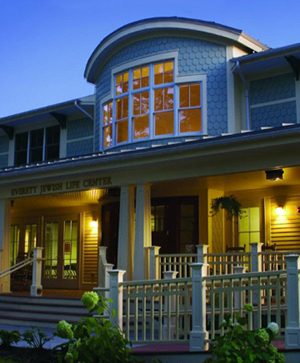

If we'd wanted.  But we didn't. We were more interested in rubbing shoulders with Christian fellow humanists than in bunking with our own kind, although we certainly did check in at the local branch.  The Everett Jewish Life Center, built in 2009, was beautiful, with the same lush hostas and hydrangeas and welcoming, wrap-around porches and rocking chairs as all the other denominational houses, only newer.  More horizontal Danish modern than Victorian gingerbread. And a schedule of films, talks and classes for all and any Chautauquans. I'm pretty sure I saw Rabbi Telushkin, a scheduled speaker, walk out of the place on his way somewhere.   

We booked a tiny efficiency in one of the Victorians on the streets between the town square and the lake. A bedroom not much bigger than the bed, a living room/kitchen by virtue of a couch, an end table and a wall-mounted TV, and half a little balcony with a partial view of the lake.   A sign on the door in our hall warned that an alarm would sound if opened; it clearly gave out into the other apartment that had been carved out of the third floor.  We saw and heard very little of our neighbors, who of course, turned out to be Jewish.  Fellow first-timers, the husband was a lawyer  from the DC area. The wife had heard of Chautauqua through her Hadassah group.  

And that's the way it went. We kept bumping into Jews, sometimes on purpose and sometimes not. Maybe it's because that week's theme was comedy, in collaboration with the National Comedy Center planned for the nearby city of Jamestown, birthplace of Lucille Ball (not Jewish).  Maybe because my husband has a clearly Jewish punim and I'm identifiable with just a little more Jewdar, I think, and a good ear.

We met a couple at a church basement supper; I was ready for an intercultural encounter until the husband told me how his dad had grown up on a south NJ chicken farm. Ah. A recognizably Jewish story; every Jew in Jersey knows someone whose grandparents raised chickens in Vineland.  These folks eating nice goyisch turkey with us lived around Raleigh. She had a southern accent, even, but was Jewish from birth, a retired teacher.  He, another lawyer, told me about the time he had a blurb published in The New Yorker.

Bennett ran into a couple in the ampitheater who had lived in Queens and used to go to the same smoked fish house as my father and uncle.

I did meet some non-Jews.  On Friday night a local pastor gave an outdoor tour of Palestine Park. Established by the original Methodist educators back in 1874, it is a lumpy, bumpy acre or so by the lake with a little water-filled ditch and puddles on two ends.  With a little imagination, the ditch is the Jordan River and the puddles the Sea of Galilee and the Dead Sea.  The bumps and some valleys are marked with plaster plates, for Jerusalem, Nazareth, Jaffa, Moab, Bethlehem and other sites of Christian interest. The hill formed by a hundred-year-old gasoline tank, for the motorboats, is Mt. Hermon.  Wikipedia relates that Chautauquans used to arrive by ferry across Chautauqua Lake (the Mediterranean) and so set foot first on a scale model pilgrimage to Jerusalem.

The pastor's talk was just historical and ecumenical enough for general, if not cynical, audiences. He gave everyone plastic shofars to blow at one stop, and put on a big talis at another. He gave us a sample of frankincense and myrrh to smell. I was good at translating whatever Hebrew words he gave us, but my Biblical knowledge was uneven, my New Testament absent. I spoke with him a little bit after his tour; enough to hear him wishing, in so many words, that Muslims and Jews in today's Palestine could better follow some of Jesus' teachings.


Among the Jews we met on purpose, I found ten by attending a Yiddish conversation bring-your-own bag-lunch at the Everett center.  We sat around the dining room table and had great fun speaking bad Yiddish.  Using rusty, home-grown vocabularies, none of them seemed to know their proper past participles. ( Ich bin gegangen instead of Ich hob gegangen.)  My relatively grammatical, college-learned Yiddish won kuvid.

The leader of the conversation group, a Buffalo woman of 82, told us that Jews first came to Chautauqua as musicians in the Chautauqua Symphony.  Before fair housing laws were passed in the sixties, restrictive covenants made owners agree in writing not to sell their homes to Jews or blacks. (My church basement brother told me that the Jewish influx had pulled Chautauqua left.  Certainly, if any Trump supporters were lurking on campus that week, they knew better than to say so out loud.  Mention of his name drew boos and hisses like Haman on Purim.  They could've given out groggers.)

 The Buffalo Yiddishist had been coming for generations.  I also learned that the 2017 rebuilding of the ampitheater, the hub of a Chautauqua week -- was financed in part through a Jewish hand sanitizer mogul.  

Also at the Yiddish lunch: an opthalmologist, a psychiatrist from New York, a young student, and an entomologist, 70-plus Lutheran widow of a prominent Jewish agnostic geneticist who nonetheless asked her to keep their kitchen kosher. She just came to hear the language spoken. It being Chautauqua, she fit right in.


Wednesday, August 16, 2017

Chautauqua: The liberal interfaith bubble on the lake.

A lot of my friends had heard of Chautauqua Institution, but I never had.  That's fairly unusual. Unless it has to do with Game of Thrones, I'm typically well informed.  Maybe it's because outside my Jewish bubble in the outer boroughs and northern Jersey, at least until recent years, most of my friends have been Catholic, and none have been musicians, opera singers or dancers.

Chautauqua Institution is a cultural, spiritual, intellectual, recreational and politically liberal utopia way out in the southwestern part of New York State, where Route 17 turns into 86 and falls off the edge of the earth. It occupies one and a half miles along the western shore of Lake Chautauqua, and typically numbers about 8,000 residents during its season.
Chautauqua lakeside, with bell tower.


It's been there since 1874, when John Heyl Vincent, a high-minded Methodist deacon, started it as a summer retreat and training ground for Sunday school teachers.  It comes out of this humanist mainstream Protestant tradition,  and started at the same time as other Methodist camp meeting grounds I'm more familiar with, like Mt. Tabor in Parsippany, NJ, and Ocean Grove down the shore.  It has since accumulated "demoninational (guest) houses" and interfaith programs with most other flavors of mainstream Protestants, as well as Catholics and, eventually, Jews. Today, even the odd Muslim or two.  Still, at least on week six, overwhelmingly white. Yes, they're aware. Yes, they're a little embarrassed. 

It's a place and a collection of nine separate week-long programs, organized around themes of current societal concerns. Week Five's theme was The Supreme Court: At a Tipping Point? Week Six's was Comedy and the Human Condition. Lewis Black, David Steinberg and W. Kamau Bell spoke on three separate mornings. Capital Steps performed one night.  
Susan Sparks, a former lawyer/Baptist minister/stand-up comedian, and Bob Alper, a rabbi/stand-up comedian, spoke to a packed Parthenon (the "Hall of Philosophy") in the afternoon and performed on two evenings in the parlor of the grand old hotel. Dean Obeidallah, an Italian/Palestinian/American lawyer with his own show on SiriusXM radio, packed another session.

At the same time, Chautauqua offers a whole college campus worth of classes  in anything you might put a good dent into within six days; pottery and robotics, for example.


To picture Chautauqua Institution, think of  narrow streets of closely spaced Victorian guest houses , studios, churches, a lakeside bell tower, a Parthenon-shaped meeting space and many denominational houses where you can also rent a room or attend a discussion. Add a day camp, sports center, sailing center, Victorian hotel, steamboat landing, and countless profusions of hydrangeas, cornflowers and black-eyed Susans. Also a 5,000-seat, roofed amphitheater, where mostly older Christian folks come in the morning to sing interdenominational hymns and hear the huge organ and the visiting preacher. (On Week Six, this was the stand-up Baptist preacher comedian Susan Sparks. We came, too, fitting the age demographic and sort of faking the rest.)  


It's also where you go to see ballet, or the resident symphony orchestra, or the headlining speakers, speaking on that week's scheduled theme. For those you scan in your weekly program pass; they sell for around $475.

All the hotels and guest houses, and private homes too, have porches and/or balconies, with wicker furniture and hanging flower baskets. Brick walks thread between the denominational houses and around the town green. 

Everyone is so pleasant and friendly, you'd think you were a little further north. In fact, many Chautauquans are Canadian; Canada must have had its Methodists and Toronto is much closer than NYC. Maple leaf flags fly from many of the porches and balconies, alongside the stars and stripes. The denominational houses all prominently post their schedules of services, talks and teas, and many front gardens feature these primitive statues of singers, lined together with outstretched arms and varied skin tones.


There's very little vehicular traffic, except for the shuttle buses that take you around and out to the off-campus parking lots.  People bicycle everywhere and not only don't they lock their bikes, they leave helmets hanging on the handlebars. The signature figure of a Chautauquan (we are all Chautauquans for the week, some for generations) is a sixty-something walking to his next thought-provoking lecture, seat cushion in hand.

Many years ago the heart of Chautauqua activity was moved uphill from the lakeshore to a town green a few blocks away. That's where you'll find the administrative offices, the interior visitors' center (the other one is on the road, before you scan in), the bookstore, convenience, tchotchke, and clothing stores, beauty salon,  cafe, ice cream parlor, and library.  There's a four-sided stele in the middle of a fountain in the middle of the green. Each side, with its own bas-relief figure, represents one of Chautauqua's four original purposes: Science, Art, Recreation, and Religion.  Art looks Roman or Greek. Religion must be Moses, carved in an ecumenical gesture holding the Ten Commandments, in Hebrew letters.  It's just that he looks less Moses-like than Charlton Heston; his face and hairstyle say Jesus.

There is something Disneyesque about Chautauqua; the architecture can bring Main Street, Magic Kingdom to mind. But it's a two-way street.  There is no visible merchandising; it's all tastefully soft-pedalled in the bookstore/gift shop. Chautauquans create their bubble as they experience it. They contribute to the ambiance with the way their children play there, they set up easels and paint, they enter a Harry Potter costume contest, they sit and chat on benches, or walk their bikes through. 

You can also pretend you're in the River City, Iowa time and place of The Music Man. The large brick library has the donor's name on it, right on the square. There's an annual parade of the current and past graduates of the Chautauqua Literary and Scientific Circle -- started over 100 years ago as a book club, a remote course of study with a summer residence and a way to spread Chautauqua's mission of lifelong learning. They carry the beautiful old fringed banners from every graduating class, going back to the twenties, and they're accompanied by a brass band.  

This can indeed remind you of the social betterment intended by the River City's ladies' auxiliary, forming living tableaux of Grecian urns.

But ... we don't want to make fun or burst the bubble. We only want to climb in.  And then because the ethos of the place is so world-embracing -- we want other peoples to want to climb in, too.  And be careful not to pop it.


x

Sunday, January 22, 2017

NY2NJ boomer marches in DC

Well.  What kind of New Yorker, boomer, Jew, chronicler and most of all Hunter Girl – from our all-girls high school years -- would I be if I hadn’t gone to the Women’s March yesterday? 
I even went to the DC one, after three different girlfriends considered the trip and changed their minds, opting for local marches instead.  But, in fairness, I had an extra inducement; my daughter and her fiancĂ© live there.  I could also spend a couple days with them.  And I had a free place to stay – combining activism and cheap getaway. 

So I get to say I was a part of the mother march in Washington. I got to buy the t-shirt, carry the sign, and show off pictures on Facebook.  I got to feel the climbing excitement and shared purpose, from the first sight of pussyhat wearers getting out of cars on my daughter’s quiet, Connecticut Avenue side street, to the jammed Metro trains at the station, to the converging streams of people – young, old, male, female, straight, gay, white, black, Asian, some pushing walkers, some strollers – heading from the downtown station to the Mall. 


The crowds were too large to find room on the train where I entered; I had to go north three stations to find room to go south.  They were also too large to let us off at Judiciary Square, the closest station to the march’s starting point; we surfaced somewhere on seventh street, near Chinatown.


I had three other friends who were going from NJ, by different ways, but as we kind of expected, we never met up. The crowds were too large to get cell signals to communicate, and just getting from point A to B was frequently impossible.  What’s amazing is how mellow the crowd stayed, when other people packed so densely might have panicked and started a stampede.  It’s made the news that anywhere from half a million to a million or more people there managed to generate zero arrests.   I’ve seen nothing to compare that with since the Simon and Garfunkel concert in Central Park; 1981, right?

I appear to have aged out of some of the shortcuts to the rally,
People were helping each other over this wall, but they all seemed 
20 and 30-something.


There was also zero visible security; no bag checks, no metal detectors to go anywhere but inside the museums.  March publicity warned people not to bring backpacks, but I saw several.  March organizers and guides were sparse, and bullhorns moreso. 

No, mellowness prevailed, even though the underlying motivation for our coming was fury, anxiety, loss and disbelief at how such a psycho, know-nothing fraud had managed to become president, and more  --- replace such exceptional integrity and intelligence. There was comfort in just being among so many like-minded people, so ready to be seen and heard, carrying sentiments that were not only right, but correctly spelled.

More than mellowness; strangers were quick to help each other scale walls, navigate fences, and to share snacks and information.  It was cold and damp, but spirits were high and warm. Rivers of people just flowed, holding signs, wearing the hats, chanting chants, drumming drums, taking pictures.  Few of us could get close enough to even see a Jumbotron at one of the intersections to Independence Avenue, nevermind an actual speaker. 

I only managed to follow people to a fenced-in area by the Air and Space Museum facing Independence, to hear Michael Moore teaching us the number through which we could contact our congresspeople and senators – every day.  202-225-3121.  Some ground cover got trampled on; I bet Trump complains about that. We were pretty careful around the shrubs. There were many in the trees, just like the olden days in Bryant Park or Central Park.


The signs were frequently inspired.

Unable to meet up with friends, I started conversations with many friendly, like-minded strangers, from the family of four on the Metro, who’d traveled four days by train from Pacifica, Calif.,  to the two young women friends in the cafeteria of the Museum of American History, one white, from Brooklyn, one black, from suburban Maryland, to the Hispanic couple from Los Angeles in the same cafeteria, who liked my recommendation to take in the Newseum the next day, to the “Nasty Nine” Jewish women from Chicago who I caught up with in a gridlock near the Washington Monument, to the two fifty-something women in the Lebanese restaurant back near my daughter’s neighborhood that evening, who I clapped with whenever the TV screen showed the day’s crowds. All literate, riled-up people with working bullshit detectors. Many able to afford a plane or a train ride across country to join up and speak out. 

As marchers paraded past, several entertainers on the sidelines 
siphoned off afew for a few minutes of dancing or listening


At the American History Museum
I got to take a nostalgia break.


Post event, about 5 pm on the Elipse. A spirited drum circle and a ginormous display
of contributed/abandoned signs. Mine's the yellow one in Russian and English.
 Thank you Hannah for the quality translation. I could tell by the thumbs up who could read it.


A day later, we can read all the analysis and counts; we can feel a movement launching.  But now I need to know what tools we really have.  What our leverage really is, as Senate, House, and White House all start to carry out their “promises,” i.e., threats.  There are so many; the cabinet appointments alone fall into the three categories of useful idiot, unscrupulous opportunist, and reactionary. 

What can work?  Making sure the investigations into Trump’s Putin connection aren’t quashed by Trump himself, now that he’s in power?  (The lady in the Lebanese restaurant has it on good authority that there were Russians toasting each other in Trump Tower on election night, and that they’ve got him over a barrel,  somehow… just wait till the dots are connected.) Or the conflict of interest angle, starting the impeachment process via emoluments violations?

We must quickly get past the understandable pride of knitting pussy hats and attending mass demonstrations and recognize this event for what it is: a kickoff.  Then we have to make more history, and in this kind of effort, it just possibly may take more time, energy and guts than anyone born after 1952 has ever had to summon before.


Wednesday, November 9, 2016

Letter to a Jewish Trump-Supporting Friend

I don't feel like having lunch today. And I don't believe I'll see, it'll be ok. 

The Electoral College has just proven to women that a man who has a dozen women willing to come forward with charges of sexually predatory behavior can still be elected president.   What use is coming forward?   Do you feel disempowered?  I do.

We have also proven that failure to pay income taxes or one's contractors is no impediment to high office.  I'm a contractor.  So my "smartest" clients are my biggest risks?

That complete disinterest in the legislative process does not disqualify.  

That complete lack of compassion for those less fortunate, due to circumstance or disability, doesn't matter. 

That inability to focus or concentrate doesn't matter; you can prepare for the highest office in the country by "watching the shows."  On Fox. 

We have trusted a man who cannot be trusted with his own Twitter account -- his advisors finally shut it down in the last days -- with the ability to launch nuclear weapons.

David Duke is ecstatic; have you read his reactions?  The other Trump supporter among my Facebook friends is inviting Whoopi Goldberg to shove off for Canada.   Black woman, Jewish name.  He has no use for either; he's all resentment.  He thinks the "other" is eating his lunch.  He scares me.

People have voted with their lower intestines, not their brains. 

We have also proven the danger of only reading and watching what you want to see and hear.  Had I forced myself to watch Fox more, I guess I would have been less surprised and perhaps less complacent.  Had you read the New Yorker, you would have heard different voices, perhaps come to different conclusions.  

This election is an embarrassment to the world.    And part of a global, nationalistic trend that has come to terrible grief in the past.

I cannot reconcile your vote with your intelligence; I chalk it up to your authoritarian streak.  Your idealization of the past.  It's consistent with your admiration of the most hidebound, insular, conservative type of Jew: Hasidim.  They have one morality for their own kind -- or those they think they might persuade to do more morally arbitrary mitzvahs --  and little to none for anyone else. 

Yes I too miss some things about the past-- like Walter Kronkite -- but none of them turn me towards Trump.  My sister lives up in Suffern, near the Hasidim who have cynically joined school boards, starved the local schools their kids don't attend, cheated welfare, busted neighborhoods, and earned the fear and contempt of everyone around them.  Don't get her started on Hasidim.

Like our friend Bill and other liberals, I was educated to think critically and to evaluate things by humanistic bottom lines, for everyone alike.  

My whole graduating class is grieving with me. 

I'm sorry, this is a very black day.  I cannot be less angry about this than your sister is. 

Ellen

Wednesday, April 20, 2016

The Moment Bernie Lost My Vote


First I have to admit that Bernie never had my vote sewn up.   I'm not his demographic in the first place; being a registered Democrat and a female boomer, I'm more likely to be for Hillary anyway.

I am certainly sick of Citizens United, and the outsized role of money in politics, and the favoritism the U.S. shows sinking corporations over sinking schools and infrastructure.  And I favor lots of other things Bernie espouses, with the glaring exception of his stand on gun control.

Tipping point: Wrong holiday, right metaphor,
right letter.
But then there's the electability thing.   A friend down in Atlanta, outside my blue Northeastern bubble, tells me there's no way America is ready for President Bernie. I surely don't want to risk a Trump or a Cruz or a Kasich presidency, and I frankly can't believe that Hillary hatred is so strong that Bernie would make a better bet against the Donald.

And there's the nuance thing.  A story in the Times reports that according to studies of their delivered speeches, Hillary's show much more actual cogitation and careful weighing of complexities, as opposed to the more single-minded notes struck repeatedly by Bernie.

I think it was David Brooks who wrote, also in the Times,about the importance of being able to hold competing truths in your head at one time, and to navigate to the best trade-offs between them. That's where things actually happen. Thanks, Bernie, for pulling Hillary to the left.  But I really like thinkers; the nuanced ambivalences of Obama in his Dreams for My Father book made me extra happy to vote for him.

The specific instant that I decided against Bernie was the one that demonstrated that single, simplified story line... the moment he quoted that  grossly exaggerated death toll of Gazans during the last Israeli response to Hamas shelling and bombing.

You want to call that response disproportionate, that's your right and your call.

But like we say, you're not entitled to your own facts.   And the fact that you would just repeat whatever was handed to you, by propagandists, shows a disinterest in the fine points.  And in accuracy.  .

Being anti-Netanyahu would not have cost you my vote.  Being against Israeli policies, ditto.  You got props for standing up to AIPAC and if you demonstrated that being critical of Israel is now a politically survivable thing to do, that would also have been all right with me.  I even believe you when you say that long-term, you have Israel's best interests at heart. Most left-of-center Jews do.

But you can't just repeat what's shoved at you. That tipped me over into the camp I was leaning toward, anyway.  So bye-bye, Bernie.


Saturday, January 2, 2016

Roots Tour Part XIII: Postscript

It is now more than six months since our trip to my grandmother's home town and environs in Poland, time to write some sort of summation, and more than time to start working on the new leads it gave me.

I went there to prove that the towns my grandmother spoke of -- Tarnow, Rzeszow, Przeworsk, Jaroslaw and Przemysl -- were places that exist in real life, that you could visit. I went to get some sense of what Esther's native country looked like, even close to a century later. To stand where she and her sisters and brothers must have stood. To travel the east-west road that links these towns together. And, I guess, to affirm our place in eastern European history, in the minds of people who live there now and in the minds of people here, too.  To connect destroyed past to present.  Not an original goal, to be sure. 

In what way did my walking these old streets, visiting these restorations and ruins respond to such thorough destruction?  Because that thoroughness is one inescapable takeaway of such a trip.  It takes research and some imagination to find the skinned and gouged-out traces of Jews in these towns.

My only answer is that in the end, we are all reduced to pieces of history.  And all you can do for these relatives, in consolation or reparation, is recover and preserve their lost histories, to endure alongside your own.  Rescuing relatives from historical oblivion is what Daniel Mendelsohn had in mind in his riveting account, The Lost: The Search for Six out of Six Million.  I didn't have the time or resources to scour the world like he did, filling in my murdered relatives' histories and settling vague theories in first-person testimony.  In addition to visiting their towns and interviewing still-living neighbors, Mendelsohn also got to the right survivors in places like Australia, just in the nick of time in 2006, months before their deaths.

What  I did see in person were records, in their originals, that testified to my grandmother's and her family's presence. Six months later, I sent a Christmas card to Malgorzata Woloszyn, the museum historian who brought out and showed me the census books. I remember her and that moment fondly.  I wish she'd email me back.  But I do have a favor to ask of her; simply to rephotograph one of the pages I shot; the most important page came out blurry.   Probably because I promised not to use a flash.  Or because I was excited. Or both.

I also brought the "Anne Frank of Przeworsk" Polish diary that I bought in the museum, by Basia Rosenberg, to a Polish friend here in NJ and she's been working on translating it.  I may offer that to the museum; neither Elzbieta nor I want anything for it but to spread this history to wider audiences and set more visitors on my path.

Once I got home, things I found by googling added to what I'd learned and seen.  I found an  amazing postscript to the little "Jewish Cemetery" monument,  its inscription crumbling in a corner of the Przeworsk bus station that covers my ancestor's bones, in a recently published book, "Jewish Spaces in Contemporary Poland," by Erica T. Lehrer and Michael Meng.  Google took me right to most of the relevant pages; I bought the ebook for the rest.

Seems that  in the early eighties, Przeworsk's municipal council decided to build a badly needed bus station on the site of the former Jewish cemetery. A road widening between Rzeszow and Przemysl had already disturbed much of the site. There were no surviving headstones and presumably no visitors.  But the decision to build on the site had one dissenter on the council:  One Jan Sasak.  Outvoted,  he suggested that the town at least erect a monument to mark the spot's former existence.  Again, outvoted. 

But, as history would have it, this Jan Sasak was himself a stonecutter.  So he made the little monument himself, and had it erected in the middle of the station.  Without his knowledge or consent, it was later moved to the back, in a corner on a small bricked rectangle.  Google Streetview still shows it, but only if you know where to look.  And that is why this little monument looks like an unofficial afterthought.  It's certainly unofficial; one man's professional act of righteous, compassionate obstinacy. Does anyone know this man?  Does he still live? Can't find him on Facebook.  I'd certainly like to thank him for this act of historical rescue.

I keep in Facebook touch with Jakub Lysiak, our guide to Przeworsk, Jaroslaw and Przemysl.  He has sent me the info should I want to get more research done on my behalf in the Przemysl archives.  I should follow up on that.  Last I heard he was applying for training as a guide at the Polin Museum in Warsaw.  I'm also Facebook friends with Helise Lieberman, director of the Taube Center for the Renewal of Jewish Life in Poland.  Both their paths cross with Agnieska (Agi) Legutko, a Yiddishist  from Krakow who I met when I booked her for an adult ed presentation at my synagogue in NJ years ago. Today she heads up the Yiddish department at Columbia in NYC.

Then there's the surviving distant relatives newly turned up by Anna Przybyszewska of Warsaw's Jewish Historical Institute; third cousins, perhaps, whose existence is documented by pages of testimony they gave to Yad VaShem in the fifties.  The survivor's name: Chaim / Henryk Schopf, of Tarnow.  Married to a Helena Eisen, with two kids, a Jan and a Ludwig.  His testimony says they made it from the nearby Krakow ghetto to Budapest in 1943, and presumably all made it to Israel.  I have other third cousins in Israel who exchange messages with me all the time; how could they not know of these others in such a small country?  There's a mystery to which I could apply more time and money. 

I would like nothing more than to swim around in these records and mysteries as a full-time occupation.  I have a lot of the language skills and more than passing familiarity with the more popular tools of online genealogical research.  What I have done is given introductory workshops in Ancestry.com to my synagogue, and, with my Lifelong Learning cochair, gotten a wall-sized map of eastern and central Europe printed on sturdy vinyl and hung in the social hall. The idea is to encourage others to research and mark their ancestral towns within its borders.  (We've added inserts of Israel, Iraq, Spain and Sudan for our few Sephardi members.  And Italy for inter-marrieds.) We've just gotten started.

Then there's Poland, a place the grandmother I knew certainly didn't care about, and who could blame her.  I follow its politics a little now.  The news is not good; fear of Muslim refugee hordes, among other factors, has turned voters sharply to the right, and what has made the news but a photo of the archetypical Polish antiSemite of my grandmother's nightmares, holding a bottle, in a group burning an effigy of a Hasid holding the European Union flag. What is that about?  Is that a safer stand-in for a  Muslim effigy, which would also be repulsive but at least more relevant?  Is it cowardice, a drunken  fringe element, or just the most virulent outbreak of an incurable xenophobia, expressed against the most traditional, vulnerable  Other? 

You beautiful young people I saw sipping wine and beer on the Rynek of Rzeszow, the college town, speaking other languages:  You folks who gave me the Jewish History tour map of Tarnow: Jakub: Did you go to the polls?  Did you sit this one out? Or were you simply outnumbered. And by whom.


The "renascent" Jewish community of Poland is miniscule; somewhere between 10,000 and 20,000.  I can't see that number ever approaching even five percent of its pre-war population, which would get to 150,000.  But we could become more frequent and interested visitors. Even if somewhat transient,  the community could grow. Jewish Studies is apparently popular at Warsaw University, among Catholic-born Poles. Here's hoping that with the churn of Polish generations, we will see even wider acknowledgement and acceptance of our historical relationship.   

Friday, November 13, 2015

Roots Tour Part XII: Warsaw, on our own, in the group, and the Museum of Jewish History in Poland


Warsaw is a big, rebuilt city, full of monuments and parks, stores of every kind, banks, apartment houses and neighborhoods.  I don't think my grandmother ever made it here, and if she had, she probably wouldn't have recognized it in 2015.  A huge ugly skyscraper, a gift from the Soviets in the fifties, dominates one part of town.  A restored and charming old city swarms with tourists, priests, fountains, plazas, restaurants, and sketching students in another.

Trams go through wide multilane boulevards, and parks cover a lot of what was once the Warsaw Ghetto. Words imbedded in the sidewalks show where the ghetto walls stood.

A large grassy mound in a pocket park at 18 Mila street, two blocks from the museum and accompanied by engraved boulders, marks the bunker and the actual last stand of the
Warsaw Ghetto resisters. You could easily miss it;
it's in the middle of a residential neighborhood.

Other huge monuments commemorate the Other uprising against Germans;
the general Warsaw Uprising, made by regular Poles against Nazi conquerors. 
Bronze statues of that uprising occupied a large square. 


 In one part, separated from the other figures stepping
through bombed-out walls, were figures of women,
men and a child.


An adorable little toddler in a sundress, in babytalk Polish that even I could understand, pointed to each figure, telling her big sister, "This is the mommy,this is the daddy, this is the baby."  It was such innocent sweetness, so 
oblivious to the suffering and fear the monument was meant to commemorate. 

It made the perfect epilogue; you wanted history to stop right there. 

The End.  Sunshine and flowers and baby bonnets.

We dragged ourselves back to the Radisson, showered, napped, and went out again, spending a couple of hours in the new Polin Museum of the History of Polish Jews -- very recommended -- which shares the plaza with the Warsaw Ghetto monument erected in 1948.   The museum's poetic design and rich, experiential exhibits show  the collaboration of Jewish and Polish scholars, curators  and historians from all over the western world, and similarly impressive international fundraising muscle, with internationally recognizable contributor names.

If you're looking for evidence of current Polish anti-Semitism, you can find it in the Google translations of online comments on Polish news sites, complaining how the Jewish Polish museum gets prime Warsaw real estate and hundreds of millions of dollars, while plain Polish museums starve for funds in inconvenient locations. 
But if you're looking for evidence of current sympathetic Polish interest in the Jewish Polish past, you can find it in the museum itself; most of the people we saw reading the walls, viewing the exhibits and pressing the buttons on interactive displays were using Polish to do so. 

And the museum is quite determinedly retelling the story of Jewish life in Poland, from about 960 up to the re-nascent present. Using writings that start with early Jewish traders from Muslim Spain, it tries to recreate some of the feeling of medieval Jewish quarters of Krakow and Kalisch and Poznan.


The call of Zionism; a radiating sun that too few followed in the 30's
It has more modern sources in representing the Jewish textile industry of Lodz,or the Yiddish literary hum of Warsaw. It puts Jewish Polish history where it properly belongs, in the context of the wider world. And like most modern museums, it's not so much about artifacts and exhibits as it is about stagecraft, screens and theme-park-like recreations, with streets you can walk through, train stations you can sit in, sounds you can hear, videos to watch and tools you can operate. It is also most deliberately telling this story to Poles as well as tourists, Jewish and non. Making this point, its web site opens first in Polish, although English is just a click away. And for all its concern with life, and for all the many places in Poland that describe the death of the great majority of its Jews, the Polin museum gives full weight to tragic ending, too, with resources that are unique to Warsaw.  Chief of these is the Emanuel Ringelblum archive.  Quotes from those buried testimonies narrate Ghetto-related exhibits, and with special force, go into more detail than you'll find elsewhere.  You'll also learn what total ruin looks like in a 20th-century city.


The final word in the exhibit is given to present-day Jews in Poland, in videos displaying attempts at cultural revival in a handful of cities.  (Historical restoration is being carried out in many others.) The thing to note is that where Jews are concerned, Poles are only 25 years past an imposed historical blackout, Nazi occupation having been immediately followed by Soviet suppression.  And Poles may not have had Jewish history uppermost in mind after the fall of communism. They are quick to tell me how that epoch was followed by years of economic chaos from which they have not yet fully recovered.

We got back to the Radisson just in time to meet our tour group at dinner, Americans from all over, with a fair number from Pole-rich Chicago. Our tour manager, Michael, was a forty-something husband, father, and natural educator from Vienna, a full-timer with Gate1Travel.  A European academic (PhD in economics, if I remember correctly) slightly more post-war (i.e. younger) than us, with what I sensed as guilt-free, cross-cultural sensitivity and bonhomie. I'm glad I have videos of some of his backgrounders on the bus, and I strongly recommend his tours.

After touring the restored old charming part of Warsaw the next day, with its squares and church towers, and learning some modern Polish history at the statues of Chopin and Pilsudski,my husband and I spent another four hours in the Polin museum on our free afternoon.  There might have been five or six other Jews in our group, but as far as we could see, none of them made it there. 
We couldn't believe it.