Translate

Showing posts with label Jewish Roots. Show all posts

Friday, November 13, 2015

Roots Tour Part XII: Warsaw, on our own, in the group, and the Museum of Jewish History in Poland


Warsaw is a big, rebuilt city, full of monuments and parks, stores of every kind, banks, apartment houses and neighborhoods.  I don't think my grandmother ever made it here, and if she had, she probably wouldn't have recognized it in 2015.  A huge ugly skyscraper, a gift from the Soviets in the fifties, dominates one part of town.  A restored and charming old city swarms with tourists, priests, fountains, plazas, restaurants, and sketching students in another.

Trams go through wide multilane boulevards, and parks cover a lot of what was once the Warsaw Ghetto. Words imbedded in the sidewalks show where the ghetto walls stood.

A large grassy mound in a pocket park at 18 Mila street, two blocks from the museum and accompanied by engraved boulders, marks the bunker and the actual last stand of the
Warsaw Ghetto resisters. You could easily miss it;
it's in the middle of a residential neighborhood.

Other huge monuments commemorate the Other uprising against Germans;
the general Warsaw Uprising, made by regular Poles against Nazi conquerors. 
Bronze statues of that uprising occupied a large square. 


 In one part, separated from the other figures stepping
through bombed-out walls, were figures of women,
men and a child.


An adorable little toddler in a sundress, in babytalk Polish that even I could understand, pointed to each figure, telling her big sister, "This is the mommy,this is the daddy, this is the baby."  It was such innocent sweetness, so 
oblivious to the suffering and fear the monument was meant to commemorate. 

It made the perfect epilogue; you wanted history to stop right there. 

The End.  Sunshine and flowers and baby bonnets.

We dragged ourselves back to the Radisson, showered, napped, and went out again, spending a couple of hours in the new Polin Museum of the History of Polish Jews -- very recommended -- which shares the plaza with the Warsaw Ghetto monument erected in 1948.   The museum's poetic design and rich, experiential exhibits show  the collaboration of Jewish and Polish scholars, curators  and historians from all over the western world, and similarly impressive international fundraising muscle, with internationally recognizable contributor names.

If you're looking for evidence of current Polish anti-Semitism, you can find it in the Google translations of online comments on Polish news sites, complaining how the Jewish Polish museum gets prime Warsaw real estate and hundreds of millions of dollars, while plain Polish museums starve for funds in inconvenient locations. 
But if you're looking for evidence of current sympathetic Polish interest in the Jewish Polish past, you can find it in the museum itself; most of the people we saw reading the walls, viewing the exhibits and pressing the buttons on interactive displays were using Polish to do so. 

And the museum is quite determinedly retelling the story of Jewish life in Poland, from about 960 up to the re-nascent present. Using writings that start with early Jewish traders from Muslim Spain, it tries to recreate some of the feeling of medieval Jewish quarters of Krakow and Kalisch and Poznan.


The call of Zionism; a radiating sun that too few followed in the 30's
It has more modern sources in representing the Jewish textile industry of Lodz,or the Yiddish literary hum of Warsaw. It puts Jewish Polish history where it properly belongs, in the context of the wider world. And like most modern museums, it's not so much about artifacts and exhibits as it is about stagecraft, screens and theme-park-like recreations, with streets you can walk through, train stations you can sit in, sounds you can hear, videos to watch and tools you can operate. It is also most deliberately telling this story to Poles as well as tourists, Jewish and non. Making this point, its web site opens first in Polish, although English is just a click awayAnd for all its concern with life, and for all the many places in Poland that describe the death of the great majority of its Jews, the Polin museum gives full weight to tragic ending, too, with resources that are unique to Warsaw.  Chief of these is the Emanuel Ringelblum archive.  Quotes from those buried testimonies narrate Ghetto-related exhibits, and with special force, go into more detail than you'll find elsewhere.  You'll also learn what total ruin looks like in a 20th-century city.


The final word in the exhibit is given to present-day Jews in Poland, in videos displaying attempts at cultural revival in a handful of cities.  (Historical restoration is being carried out in many others.) The thing to note is that where Jews are concerned, Poles are only 25 years past an imposed historical blackout, Nazi occupation having been immediately followed by Soviet suppression.  And Poles may not have had Jewish history uppermost in mind after the fall of communism. They are quick to tell me how that epoch was followed by years of economic chaos from which they have not yet fully recovered.

We got back to the Radisson just in time to meet our tour group at dinner, Americans from all over, with a fair number from Pole-rich Chicago. Our tour manager, Michael, was a forty-something husband, father, and natural educator from Vienna, a full-timer with Gate1Travel.  A European academic (PhD in economics, if I remember correctly) slightly more post-war (i.e. younger) than us, with what I sensed as guilt-free, cross-cultural sensitivity and bonhomie. I'm glad I have videos of some of his backgrounders on the bus, and I strongly recommend his tours.

After touring the restored old charming part of Warsaw the next day, with its squares and church towers, and learning some modern Polish history at the statues of Chopin and Pilsudski,my husband and I spent another four hours in the Polin museum on our free afternoon.  There might have been five or six other Jews in our group, but as far as we could see, none of them made it there. 
We couldn't believe it. 


Wednesday, November 4, 2015

Roots Tour, Part XI, Leaving Grandma's Galician Poland, coming to Warsaw


 It's now five months since we made my roots trip to Galician Poland; I must finish my account before I have to rely entirely on photos and notes.

Still in Tarnow that Wednesday, we found a sign that said Rzeszow, near where we'd parked the car. So instead of retracing our route, we followed its arrow,  driving east on a smaller road  parallel to the A4 highway we'd come on. With the sun setting behind us, the hills brightly lit green, we passed Dembica, the ancestral home of the Jewish half of the family of my friend Pat, who grew up on Long Island.


Old Rzeszow hands by now, we made no wrong turns, pulling into the Hotel Bristol's underground garage just as night fell. We took a last walk around Rzeszow's cobbled rynek, full of echoing chatter from around the outdoor restaurant tables. In the tourist office, under the rynek one floor below ground level, a roomful of townspeople were taking dance lessons. I asked a young woman who was also watching the class from above if she spoke English and if she was local.  She did speak English but she was from Warsaw, here on business.  I explained that I was visiting my grandmother's ancestral area and she said that yes, many people from America were visiting now.  She didn't say Jews, but I'm sure that's what she meant.

On the other hand, when the tourist office had been open to the public during the day, and someone who was obviously a working student was behind the counter, I casually mentioned that we were particularly interested in remnants of Jewish presence, and it didn't elicit any unease at all. She told me about Jewish lectures and events in Rzeszow that we could no longer attend; our regular guided tour was starting in Warsaw the following evening. (Rzeszow's underground tourism office was also the entry point to the town's historic underground storerooms, which tunneled together, far around under the plaza. Had we had more time...)

The next morning, we drove our rental car with the schizo GPS to the airport, stopping at a gas station to top up en route, just like we do in Florida.  We couldn't figure out how to open the gas cap, and neither could the nice young man who worked there.  An anxious, wordless comedy ensued, with us searching the dashboard and the floor around the driver's seat while the time cushion before our flight ran out.  Finally, he motioned for our key; it was remote controlled. An age, not a language gap.


We thanked him, parked the car in front of Rzeszow's airport, dropped the keys at the counter, and  hopped the ridiculously cheap flight to Warsaw. We were probably the only foreigners in that little plane, flying over the green-blanketed landscape with the houses nestled in the creases.

Warsaw's Chopin Airport looked new and world-class. It was also cosmopolitan enough for a Chasid to walk through without looking particularly self-conscious, if they ever do. We hopped a cab to the Radisson, where our guided tour would begin at a welcome dinner.  After leaving our bags with the concierge -- it was still only late morning --  our first destination was the Emanuel Ringelblum Jewish Historical Institute, to meet Anna Przybyszewska, the researcher I'd met over the web, the one who'd helped me discover some new surviving distant relatives.

We were half an hour late, we thought, but we'd sent a message through to her that we would be.  We strode off from the hotel briskly, passing a synagogue and through a courtyard with Yiddish written on the exterior walls.  My husband had picked this direction, so I was pretty irritated with him 15 minutes later when we figured out we'd struck out in the wrong direction. We had to retrace our steps and be even later; by the time I got to the JHI, I was pretty flushed and edgy. 

Anna's office was shared with two others in a library room just off the main floor lobby of this historically Jewish, rare surviving building.  We walked in and introduced ourselves, and it turned out she'd been expecting us hours before.  A pale, slender woman, perhaps 50, with straight light hair that framed her face.  A delicate librarian look, but a piercing gaze.

 I really didn't have anything prepared to say or work on; the moment was too fraught, somehow. And anything on a screen can be done long-distance.  But my husband started talking with her at length, making me more edgy still.  Finally I blurted out, "Are you going to take all my time with her, too?"

Anna was a little appalled at this outburst. She looked at me rather sternly.  "These stories are important," she said.  "We have to hear this, too." I don't remember what the subject of their conversation had been, exactly; I just felt ashamed.  And by this Polish researcher, who had made it her mission to gather every possible detail about my murdered people.

Obviously, this work could have occupied far more people. It looked pretty wearing on her, and was not about catering to the impatience of any particular Jewish visitor, even if that impatience had 
been directed at a husband, and not at her.

We didn't make much more of the visit.  I had basically just wanted to say hello, and find out what would be involved in trying to track down distant relatives in Israel, the last evidence for which dated to the fifties. She quickly brought up our email correspondence and all the other material relating to my relatives that she had sent me.

The only other thing I remember her saying was that one had to be careful in teaching kids about the Holocaust, and not to overwhelm them with too much information at once; it could cause psychological harm.  It had to be appropriate to one's age and resistance to despair.  We left and another couple took our place.  Other people were sitting with her Israeli assistant, and the third worker.  Each specialized in different languages relevant to the documents they retrieved, were brought, and searched through.

My husband went to look over the historical exhibits on the upper floors, which dealt with the surviving ten percent of Polish Jews; the attempts at resettling and restoring the mental health of traumatized orphans (many understandably wanted absolutely no part of being Jewish), the role of surviving and survivor Jewish organizations. 


While he did that I went next door to visit Helise Lieberman, the executive director of the foundation for Jewish Life in Poland.   Helise for 20 years has been nourishing the seedlings of Jewish community in Poland with her energy, humanism, positivity and humor.  We too had been corresponding for months before my trip. She gave me a hug and she updated me on the people we had had in common; some dating to 1970, others, Yiddishists in 2015. 

Helise has represented the vestigial and replanted Jewish community to Polish prime ministers and visiting Americans for years now. She can be seen at all commemorative and holiday events, and was among those getting the enormous Polin museum project off the ground over the past decade.


Friday, August 28, 2015

Roots Tour Part IX; In which we drive ourselves to Tarnow and meet the last Jew born there. Or so he said.

Jakub drove us home from Sanok in the Carpathians; it was dark by the time we made it back to Rzeszow's rynek.  We found an ATM to get the additional zlotys needed to pay him for a long, full, memorable day.  He promised to send us the pictures he'd taken and see about forms for further research in Przemysl's regional archives.  He also came up, at our invitation, to check out the hotel for other clients.  I asked him if the glass-walled bathroom was something Polish, or merely weird.

He said it was weird. We're Facebook friends now and I'm following his career; a NY Times writer of 30 years recently wrote in the Sunday Magazine about his roots tour into Poland and Ukraine, with the "resourceful" Jakub. (The Jewish reporter also met a lot of the same people we met on our travels.)

After our third night at the Hotel Bristol, on Thursday, we undertook the most adventurous part of our independent journey in Galicia. This involved renting a car and driving it west along A4 to Tarnow ("TARnov"), our biggest Polish town yet. People back home still carry the last name, Tarnower.    

The prospect of driving a car in a foreign country had given my husband pause.  But we had already observed our guide driving; the rules of the road looked the same and the names of towns were easy enough to read on roadsigns. We had maps and we'd already navigated public buses and ticket windows. Besides, I'd already paid for it on the web before we left home. Extra, for automatic transmission.

The only place to pick up a rental car in Rzeszow seemed to be back north at the airport, so the hotel got us a cab; the driver spoke no English at all. The man at the airport car rental counter spoke it fluently, though. In a gesture of extra hospitality, he threw in an English-speaking GPS system at no extra charge.  This completely changed my husband's attitude; we were as good as guided.

Except that the GPS' directions made no sense. We knew that all we needed was to get on progressively bigger west-bound roads till we got on the major highway to Tarnow. But the GPS didn't, somehow.  Its British voice was taking us to progressively smaller, more local roads, and we were not, as far as we could tell, facing west, but east. Every time we did face west, it told us to turn around.

Then we learned that the disadvantage of driving in a country where you don't speak the language; you can't understand such warnings as "road under construction, keep left." So we wound up following another presumed tourist right up to the navigable end of some right lanes. This forced us to turn around and drive in the direction of oncoming traffic, until we could quickly turn sharply around into the lanes we would have known to follow had we been Polish speakers.  


We wound up lost in a residential neighborhood, with no sign of the highway, cursing the complimentary schizoid navigator. Luckily, the residential neighborhood in which we gave up on the GPS had a corner deli, where nobody spoke English but someone remembered the same amount of high school French as I did.  A couple a droits, a couple a gauches, and we were on the main road to Tarnow.

We drove into town -- following signs for the old city -- the stare miasto -- and parked right off Krakowskiej street -- the same street where my grandmother's cousin Chaim had had a tailor shop, at number 51.  We lucked out yet again when a meter cop, using Polish and smiling pantomime, helped us figure out one of those newfangled parking machines, the same kind that confuses us in New York.  Did he recognize our purpose?  Did he recognize American Jews?

Tarnow had had a big Jewish community, and its current city fathers seemed to know it.  We soon came upon a poster on the way into the old part of town that advertised a week of Jewish culture.  Lectures, movies, concerts, sing-alongs.  The poster was all in Polish, so this was not just for my eyes, but natives'.  The information center on its rynek was well prepared for Jewish roots seekers, too, with a separate self-guided Jewish heritage tour map and experienced, bilingual help. 


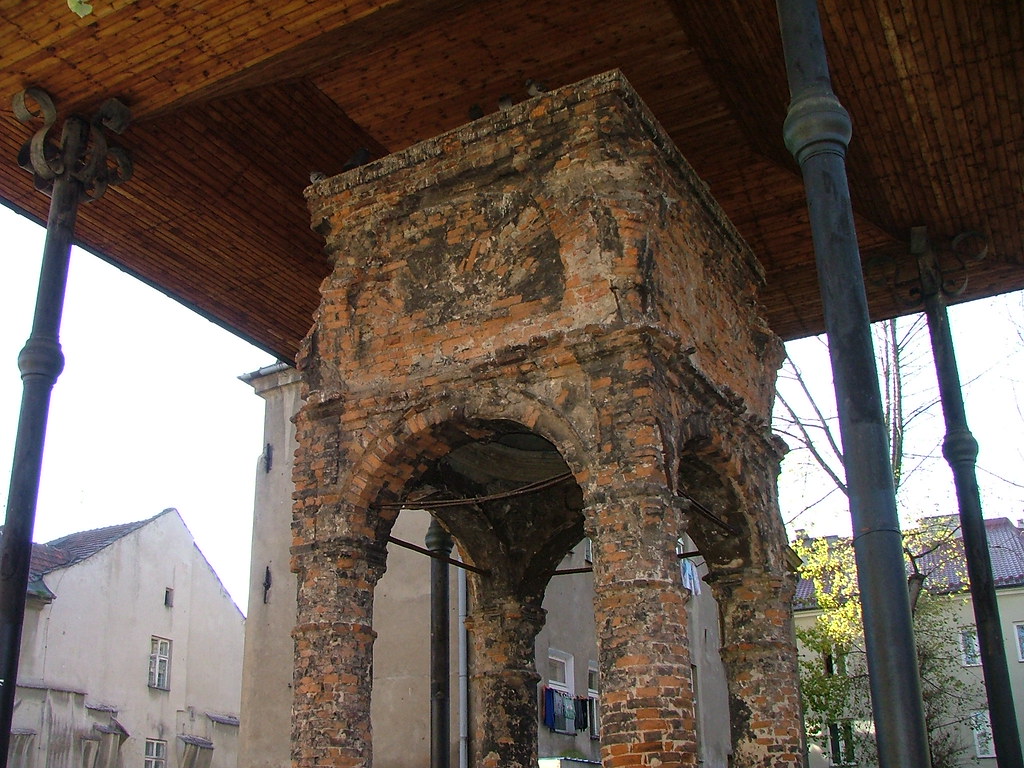
The first place on that tour was the Bima -- the surviving piece  of a 17th-century synagogue the Nazis had burnt down.  Its four pillars, skinned to its bricks, and the dome above them stood in a pocket park dedicated to this ruin. Remnants of painted wood were visible inside the dome, and on a brick wall opposite this bima were panels, in English and Polish, describing the lost world of Tarnow's Jews. 


On the cement wall of the side of a building behind the bima, some young people were painting a mural of doves.  These may have been from the storefront just across from the park entrance, the local headquarters of a Polish organization dedicated to restoring local Jewish spaces.  The organization's name was written in Yiddish letters, transliterated from Polish, over the door.


Then three English-speaking people appeared; one fifty- or sixtyish man in a Tevye-style cap, his slightly younger wife, and a fit grey-haired man dressed in artsy black, carrying professional-weight cameras.  Jews!  Tevye/Jerry was from Vancouver and had come for the annual bike ride from Auschwitz to Krakow. The camera carrier was indeed a professional photographer, a Jerry/Jerzy? Bergman, and "the last Jew born in Tarnow."  In 1948, to parents from among the surviving ten percent -- before they, too, left for more receptive places. 

Jerry Bergman had grown up and gone to school among Poles, who were apparently none too happy to have him in their midst.  He could point out his grandfather's ironwork shop off the rynek, and other personal and public landmarks of Tarnow's Jewish history.  He'd taken pictures for all kinds of international media outlets and currently lived in Denmark, but came back to Tarnow for Jewish events; he has a standing reservation for a room over the Tourism Information Center for whenever he comes.

We immediately fell to easy joking, as if we'd been friends for weeks, at least.  That traveling- incognito feeling, though it had faded over the past three days, disappeared in the company of these other Jews.  The four of us followed Jerry around through the rynek to a few blocks of Tarnow, him pointing out exactly where the Jewish streets began and ended, the rising value of property, the present owners and their trouble funding renovation, where his relatives had lived and other historical insider tidbits.  

Although Jerry Bergman spoke and gestured in a tone of understandable cynicism, he was actually quite active in the preservation and restoration of Jewish artifacts and in particular, cemeteries.  He explained how the Jewish cemeteries we'd seen had no stones because if they hadn't been destroyed and pillaged by Nazis, they'd become defenseless quarries for the local population, who helped themselves later.  Many photos of Jewish gravestones, in abandoned cemeteries or abandoned in fields, appear among his online photographs. Many wound up sanded down, re-engraved, and repurposed in Christian graveyards.


While he showed a typically Jewish, rueful sense of humor, Jerry  didn't broadcast any malice toward contemporary Poles. He seemed pleased by local efforts of organizations like AntiSchematy2 and Mezuza to restore local Jewish cemeteries. He was certainly not traveling incognito. He said he hoped we'd come to the concert at the bimah that night, and went off to his place in town to get some sleep.