Translate

Friday, August 28, 2015

Roots Tour Part IX; In which we drive ourselves to Tarnow and meet the last Jew born there. Or so he said.

Jakub drove us home from Sanok in the Carpathians; it was dark by the time we made it back to Rzeszow's rynek.  We found an ATM to get the additional zlotys needed to pay him for a long, full, memorable day.  He promised to send us the pictures he'd taken and see about forms for further research in Przemysl's regional archives.  He also came up, at our invitation, to check out the hotel for other clients.  I asked him if the glass-walled bathroom was something Polish, or merely weird.

He said it was weird. We're Facebook friends now and I'm following his career; a NY Times writer of 30 years recently wrote in the Sunday Magazine about his roots tour into Poland and Ukraine, with the "resourceful" Jakub. (The Jewish reporter also met a lot of the same people we met on our travels.)

After our third night at the Hotel Bristol, on Thursday, we undertook the most adventurous part of our independent journey in Galicia. This involved renting a car and driving it west along A4 to Tarnow ("TARnov"), our biggest Polish town yet. People back home still carry the last name, Tarnower.    

The prospect of driving a car in a foreign country had given my husband pause.  But we had already observed our guide driving; the rules of the road looked the same and the names of towns were easy enough to read on roadsigns. We had maps and we'd already navigated public buses and ticket windows. Besides, I'd already paid for it on the web before we left home. Extra, for automatic transmission.

The only place to pick up a rental car in Rzeszow seemed to be back north at the airport, so the hotel got us a cab; the driver spoke no English at all. The man at the airport car rental counter spoke it fluently, though. In a gesture of extra hospitality, he threw in an English-speaking GPS system at no extra charge.  This completely changed my husband's attitude; we were as good as guided.

Except that the GPS' directions made no sense. We knew that all we needed was to get on progressively bigger west-bound roads till we got on the major highway to Tarnow. But the GPS didn't, somehow.  Its British voice was taking us to progressively smaller, more local roads, and we were not, as far as we could tell, facing west, but east. Every time we did face west, it told us to turn around.

Then we learned that the disadvantage of driving in a country where you don't speak the language; you can't understand such warnings as "road under construction, keep left." So we wound up following another presumed tourist right up to the navigable end of some right lanes. This forced us to turn around and drive in the direction of oncoming traffic, until we could quickly turn sharply around into the lanes we would have known to follow had we been Polish speakers.  


We wound up lost in a residential neighborhood, with no sign of the highway, cursing the complimentary schizoid navigator. Luckily, the residential neighborhood in which we gave up on the GPS had a corner deli, where nobody spoke English but someone remembered the same amount of high school French as I did.  A couple a droits, a couple a gauches, and we were on the main road to Tarnow.

We drove into town -- following signs for the old city -- the stare miasto -- and parked right off Krakowskiej street -- the same street where my grandmother's cousin Chaim had had a tailor shop, at number 51.  We lucked out yet again when a meter cop, using Polish and smiling pantomime, helped us figure out one of those newfangled parking machines, the same kind that confuses us in New York.  Did he recognize our purpose?  Did he recognize American Jews?

Tarnow had had a big Jewish community, and its current city fathers seemed to know it.  We soon came upon a poster on the way into the old part of town that advertised a week of Jewish culture.  Lectures, movies, concerts, sing-alongs.  The poster was all in Polish, so this was not just for my eyes, but natives'.  The information center on its rynek was well prepared for Jewish roots seekers, too, with a separate self-guided Jewish heritage tour map and experienced, bilingual help. 


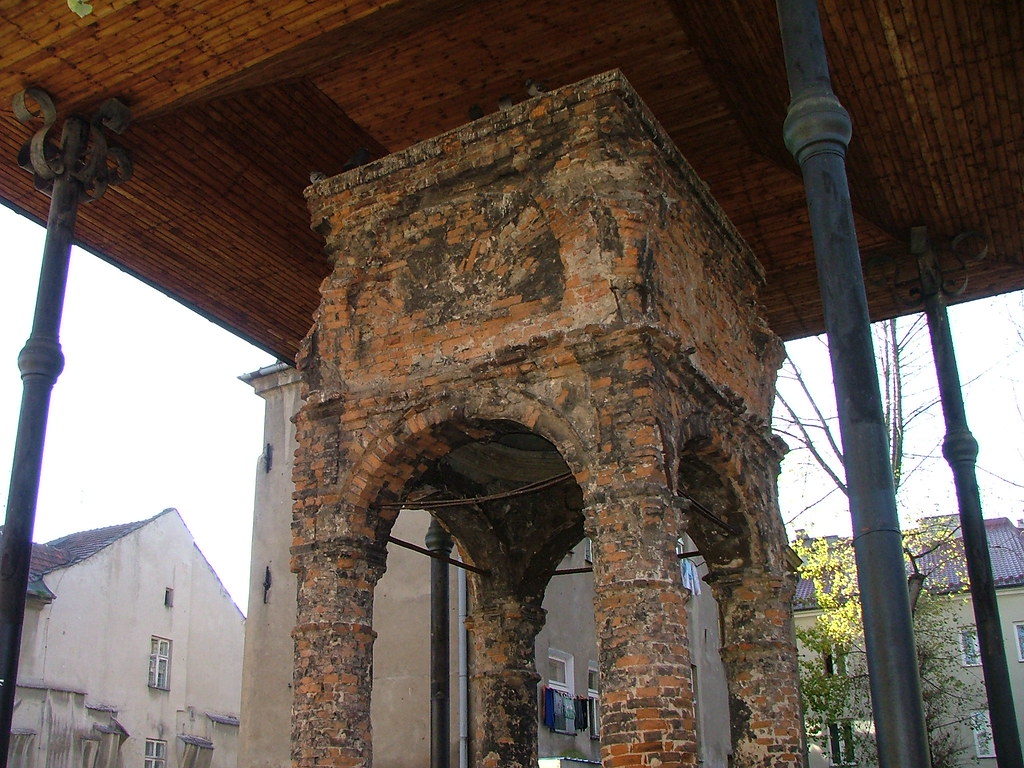
The first place on that tour was the Bima -- the surviving piece  of a 17th-century synagogue the Nazis had burnt down.  Its four pillars, skinned to its bricks, and the dome above them stood in a pocket park dedicated to this ruin. Remnants of painted wood were visible inside the dome, and on a brick wall opposite this bima were panels, in English and Polish, describing the lost world of Tarnow's Jews. 


On the cement wall of the side of a building behind the bima, some young people were painting a mural of doves.  These may have been from the storefront just across from the park entrance, the local headquarters of a Polish organization dedicated to restoring local Jewish spaces.  The organization's name was written in Yiddish letters, transliterated from Polish, over the door.


Then three English-speaking people appeared; one fifty- or sixtyish man in a Tevye-style cap, his slightly younger wife, and a fit grey-haired man dressed in artsy black, carrying professional-weight cameras.  Jews!  Tevye/Jerry was from Vancouver and had come for the annual bike ride from Auschwitz to Krakow. The camera carrier was indeed a professional photographer, a Jerry/Jerzy? Bergman, and "the last Jew born in Tarnow."  In 1948, to parents from among the surviving ten percent -- before they, too, left for more receptive places. 

Jerry Bergman had grown up and gone to school among Poles, who were apparently none too happy to have him in their midst.  He could point out his grandfather's ironwork shop off the rynek, and other personal and public landmarks of Tarnow's Jewish history.  He'd taken pictures for all kinds of international media outlets and currently lived in Denmark, but came back to Tarnow for Jewish events; he has a standing reservation for a room over the Tourism Information Center for whenever he comes.

We immediately fell to easy joking, as if we'd been friends for weeks, at least.  That traveling- incognito feeling, though it had faded over the past three days, disappeared in the company of these other Jews.  The four of us followed Jerry around through the rynek to a few blocks of Tarnow, him pointing out exactly where the Jewish streets began and ended, the rising value of property, the present owners and their trouble funding renovation, where his relatives had lived and other historical insider tidbits.  

Although Jerry Bergman spoke and gestured in a tone of understandable cynicism, he was actually quite active in the preservation and restoration of Jewish artifacts and in particular, cemeteries.  He explained how the Jewish cemeteries we'd seen had no stones because if they hadn't been destroyed and pillaged by Nazis, they'd become defenseless quarries for the local population, who helped themselves later.  Many photos of Jewish gravestones, in abandoned cemeteries or abandoned in fields, appear among his online photographs. Many wound up sanded down, re-engraved, and repurposed in Christian graveyards.


While he showed a typically Jewish, rueful sense of humor, Jerry  didn't broadcast any malice toward contemporary Poles. He seemed pleased by local efforts of organizations like AntiSchematy2 and Mezuza to restore local Jewish cemeteries. He was certainly not traveling incognito. He said he hoped we'd come to the concert at the bimah that night, and went off to his place in town to get some sleep.


Thursday, August 13, 2015

Roots Tour Part VIII: From Przework east to towns she knew -- Jaroslaw and Przemysl


Feeling victorious after our historian produced the census records from a room right behind her office, we left the Przeworsk museum for the next town, about 15 minutes east: Jaroslaw.  It was a place my grandmother had mentioned. A quick hop by car train or horse, I think the doctor had been there.  An attractive little town, it had its own rynek, of course, and two repurposed synagogues still standing.

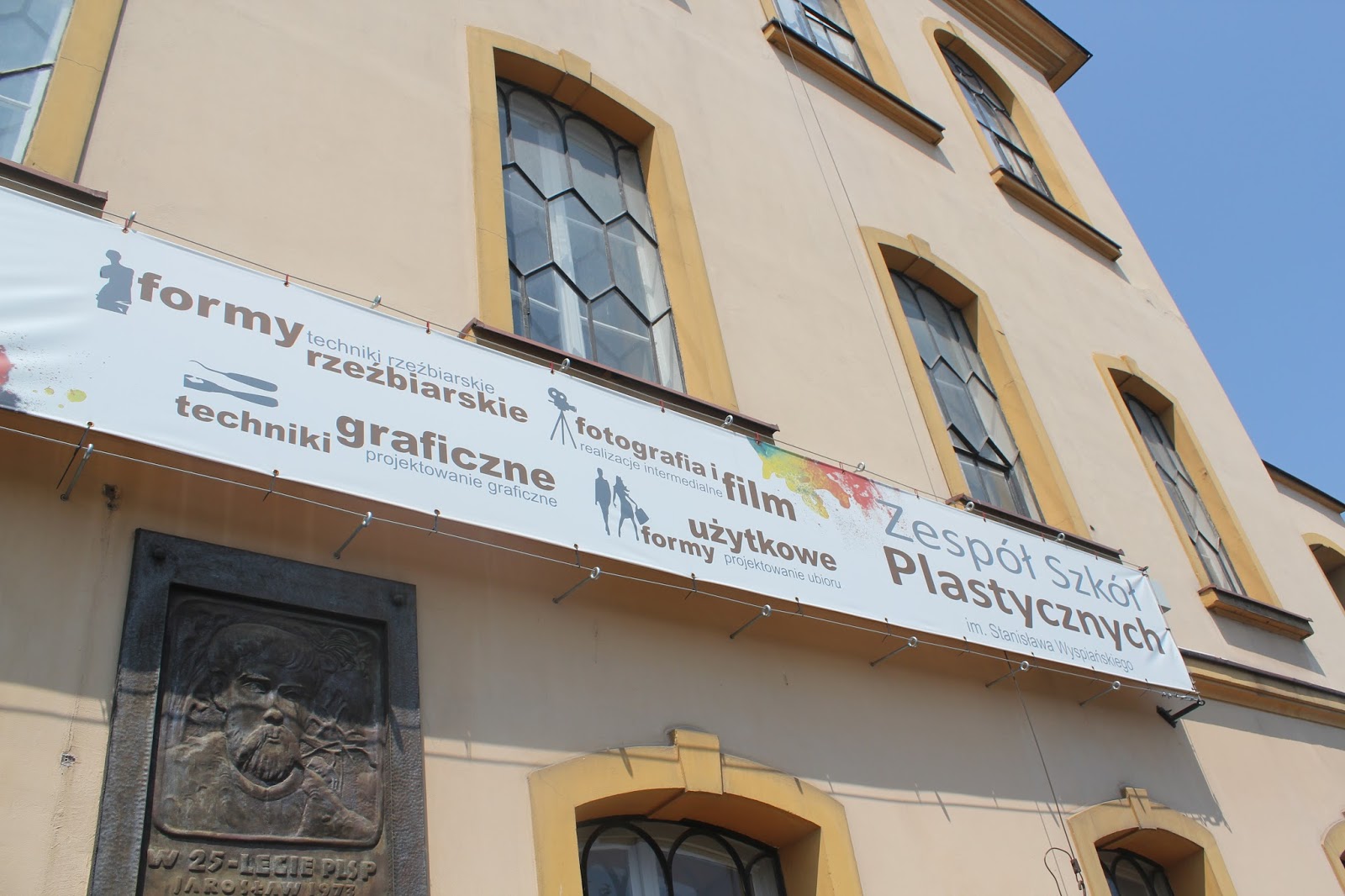
The plaque on the art school in Jaroslaw
Jakub took us inside one of them; it's been an art school for many years.  You can't tell it was a synagogue until you enter the soaring gallery of students' drawings and paintings. Then you see the high vaulted ceiling and recognize the arched windows, round and rectangular panes of clear glass where you know all the colors and the names of donors once drew the eyes of daveners. 


There's two plaques to bear witness; one of recent vintage, in Polish English and Hebrew, and an older one, in Polish alone.

 The school is on or very near Jaroslav's rynek, which also boasts a beautiful town hall, decked with plaques and statuary.


The other synagogue, the "new" one, is not being used for anything  now. Jakub said it was under new ownership.  This one had one extremely exceptional feature: the shape of the twin tablets on its pediment; a clear surviving sign of its original identity. Everywhere else we'd been so far, the Germans had been diabolically thorough about eradicating all signs of Jewish names or symbols.

Inside, the art school shows hints of its previous function.


Anyone speak Polish?  This appears on the town hall  in Jaroslaw's rynek. 


This is the former synagogue in Jaroslaw  that bears a rare surviving symbol.
We had lunch in Jaroslaw and proceeded on further east to Przemysl, a place my Grandmother refers to on a recording as a place "we knew we were already safe."  A small hilly city of three-story, ornately fronted buildings, winding streets and plenty of vehicular ad pedestrian traffic.  There we had an address from a document of the Committee for Polish Jews placing my grandmother's surviving nephew, age 2, and his mother, her sister-in-law, in 1946.

This multilingual sign describing Jaroslaw's history as a trade center typifies the Jew-free history taught all through the Communist era.  


Yes, that's a covered wagon, representing Jaroslaw's past to tourists
 as a way station among traders.  I thought those belonged to American history...  who knew? 


My husband and Jakub, chatting in Jaroslaw

On our way to that address, a mid-sixtyish local woman saw us on the sidewalk and me with my camera. Happy to see her town worthy of tourism, she eagerly asked me, through Jakub, what I thought of Przemysl. I said it looked like a nice, prosperous European city.   Along with translating my answer, Jakub asked her for directions to Przemysl's synagogues.  Although I didn't catch it, he told me that he saw her enthusiasm immediately cool. But she gave us the right directions.

Przemysl's synagogue was a big building in the middle of town; it had served first as a stable and later as a library.  Same denatured windows.  Blank old plaques where names had once been inscribed.  New historical plaques with contemporary donors.

The names erased from a place of honor
on the former synagogue of Przemysl.
The symbols chiseled off, the synagogue turned stable in Przemysl.
We left the shul and walked back the way we'd come, to find my great aunt's and second cousin's address; Mikiewicza 7.  It led to an old wooden door inside a courtyard, behind retail stores of leather goods and meat. Not neat or pretty. Weather-beaten and shabby, the door shared the courtyard with garbage bins and parked motorcycles.  People of the neighborhood asked us what we were doing there. I managed "aunt" and gestured "long, long ago."  That seemed to satisfy them.

Przemysl also has a surviving Jewish cemetery, which we visited inside its walls. With burials that dated up to 1944, its grounds near the entrance were obviously kept by someone who cared in 2015.

How was this graveyard spared? Jakub said that the Germans just couldn't manage to get to every one. They got close. The woods and underbrush were reclaiming the older stones, further back from the entrance and the road.

Two plaques adorned the entrance arch: one in Polish dedicated to a John J Hartman from the USA in 1999; the one on the other side in Hebrew and Polish to an Aharon (Arnold) Rabinowicz, who, says Google Translate,  built this wall and its iron gate in the year 1913.


Jakub had one more place he wanted to show us; something that would give us a sense, he said, of old Galicia. After at least an hour's drive through gentle Carpathian hills, that place turned out to be the curated historical village of Sanok.

 Something like Stockbridge, Mass., with admission building, tickets, map, it was assembled out of actual 19th-century, thatched-roof wooden houses and businesses salvaged from other towns around southern Poland,  mostly arranged around  a market square.  And just like a Stockbridge or a Waterloo, NJ, it had its blacksmith, apothecary, clockmaker, schoolhouse, church, weaver, tinker and teacher.

And less like a Stockbridge, it had its Jews. One Jewish house stood on the square, its front-room table set for Shabbes and papercut pictures hanging in the windows.

There was also a well-researched synagogue going up in Sanok this year,  reflecting the new tourism traffic and Jewish historical agencies at work in today's Poland.

We'd unfortunately gotten there at the end of the day. They let us in, just in time to see the watchmaker close up shop and a straggling school group get a double-speed, last-minute tour from a man who looked authentic to the place and period.  The kids looked like they could easily be from central New Jersey; that's  central and eastern Europe for you.

Finally, we and Jakub had dinner on the rynek in Sanok, after he showed us the surviving "private" synagogue of that little town.  You don't expect a Jewish presence in remote little towns in America, but there are ghosts of them in tiny towns all over Poland.  There's a historical reason for this; I think it's that Polish nobles wanted "their" administrative Jews everywhere to collect taxes for them.  Strategic to pick an unpopular minority that relied on the nobility for protection. 

Right next to our outdoor table was a coin-operated, one-seat kiddie ride; the kind of thing you'd see outside stores in my boomer childhood.  A little boy got in it, right next to his mom, and my husband offered the mom to do the shaking for him, Which he did, making the boy laugh.

The young mom spoke a little English. The little boy's name?  "Yosh."  What does he speak?  "He speaks Yosh."  We shared a little moment of the everyday sweet silliness of being a little kid's mom.


Thursday, July 23, 2015

Roots Tour in Galicia, Part VII: In which we find the one person in Przeworsk who could find a piece of proof


The three of us, led by Jakub, went into Przeworsk's Ratusz/town hall to look for records, as municipalities are supposed to hold those that are  less than one hundred years old. Older than that, and they go into regional Polish archives in bigger cities; in Przeworsk's case, Przemysl. 

The entrance to the Ratusz was now in the back, in a new addition whose construction was photographed the day Google came by in 2013.


Now it was finished and little kids played by the fountain.


We came to an office occupied by two women in their sixties; John Paul II's picture was on the wall.  Jakub explained the reason for our visit and they explained back, through him, that they couldn't help us; only marriage records were kept there.  We wanted another municipal office, they said; the one by the elephants. 

Elephants?  Were they pulling our leg?  We walked to Jakub's car, looking for elephants on signs or in store windows, then went a few blocks west on E40 until we came upon a pair of elephants on the road's grassy median. They were topiaries.  Cute green elephants, made of hedges, with red carpet saddles. And across the street from them was another office building, at the end of a flowery walkway, showing  Przework's by now familiar coat of arms, with the star and crescent.


Actually, I think there's something between Poles and elephants. They're a motif I saw painted on baroque  buildings in Tarnow and elsewhere.

Anyway, we entered this municipal building, whose halls looked just like town halls anywhere, with signs boosting  Przeworsk and everything that happens there, culturally, athletically, educationally, commercially.  We were directed up the stairs to another, smaller office, where two younger women, sitting at keyboards, also listened to our quest via Jakub. 
 
They were very sorry, but Przeworsk was no longer holding any town records; everything, recent to ancient, was now stored in Przemysl. Disappointing, but Przemysl was on our itinerary that day, anyway.  I saw a map of Przeworsk on the wall, the kind framed with squares of local advertising, and asked them if they had any more copies.  They apologized again.  We thanked them and went back down the stairs. 

Before we reached the first floor, the women called down after us and gave us the map from the wall, rolled up; a consolation prize.  I now have a nice map of Przeworsk and immediate vicinity, with the ads of many local businesses, mostly in home improvement, all around it.

Suzanne Wertheim's web page on Przeworsk had mentioned a local teacher, a Mr. Thomas, who had helped her identify old sites from pictures.  Jakub thought of inquiring in Przeworsk's public  library -- also conveniently located near the elephants.  I sat down at a PC and launched the familiar refrain of a Windows boot-up while he went to  ask the local librarians if they knew of this teacher.  Again, no luck.  And not much English, not even from the young civil servants. Sympathetic  smiles, at least. And Windows, in Polish.

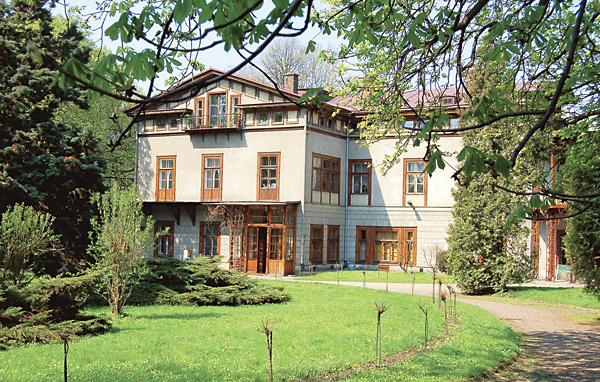
We were about to set out for Przemysl, the town after Jaroslaw, when I remembered that I'd seen a Przeworsk museum on the web.  That too, was nearby, in a park that had been another Lubomirski estate.   The museum itself looked like an old elegant country house.

I wasn't sure why I thought of the museum; I wasn't much interested in the case of surviving Judaica mentioned on their site; I know what menorahs and tefillin look like. Nor did we want to see any more aristocratic interiors, or the historical  firefighting exhibit. Again, another entrance, another explanation in the native language. 

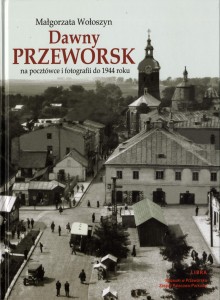
But this time we stirred up some enthusiasm.  Wait, let us get the local historian, they said. Turns out she worked upstairs.  Here, look at these books, in this case.  Here's a book of photos on the history of Przeworsk with a lot on the Jewish community, edited by this same historian. 

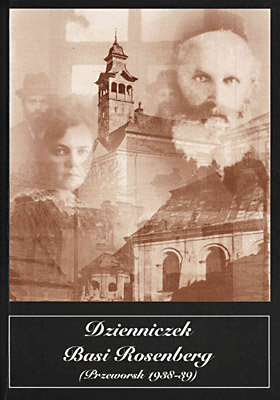
Here's another book; a diary, by the Anne Frank of Przeworsk, one Basia Rosenberg.  Well of course I bought that, and for only 8 zlotys.  Yes, it's in Polish.  I'm working on it. 

I would have been delighted to buy the book of photos, too, if that hadn't been their last copy. One of only 1000 or so printed,  it was out of print.  I'll be looking for it on Polish ebay.  We were ushered up the stairs to meet the historian, a woman somewhere near 40, I think, by the name of Malgorzata  (Margaret) Woloszyn.  She and a colleague were working on computers  in a cramped paneled room, and when we greeted her and explained our mission, she went into a back room and came back barely minutes later with some 95--to-100-year-old books of handwritten census records.

One book was an index to the others. And there, in those old lined but still sturdy pages, Margaret turned the pages to Schopfs and Schillers.  Including my grandmother, and her sisters, and brothers, and many cousins I never knew about, their birth dates, names and relation to their households, and the occupations of the head of the household, which was Krawic, or kravitz. This means tailor, which matched what I already knew.


We were all very happy, finder, researcher, interpreter/guide and husband. Here was proof, still in Przeworsk, that my grandmother, and therefore I and my family, had some connection to this town. 
 I asked her if she got visits like this much, from roots seekers, and she said that yes, she gets a few every year.

I was so excited that I took a lot of blurry pictures of the pages, and accidentally used the flash twice in spite of promising not to.  Some are sharp.  At least one page I'd like to ask her to reshoot and send me.

And I can, because I asked for her email address and she gave it to me.  I gave her my card and she stapled it into some kind of guest register.   And as soon as I finish this series -- or maybe even this post -- I'm going to write her, and Google Translate will do the rest.


The fact is that millions of birth, death, military and marriage records of Polish Jews are now searchable on the web.  I've found many and expect to find more. The Mormons gave Poland lots of money and resources to digitize all these records, in their dubious but indirectly useful effort to posthumously baptize everyone who ever lived.  So it doesn't really pay to spend too much of a short in-person visit in dusty archives.  Ms. Woloszyn herself said that these census books were going to be digitized as well. But there's still a satisfaction in seeing and smelling pages in ink and paper, in a tangible ledger, in seeing the names in that elegant turn-of-the-century penmanship. In being in the same general place where they were written, so long ago.

Now here's a really strange thing: The historian's last name, Woloszyn, is the last name of some of my husband's cousins. Bruce Wolosin, his third cousin originally from Cleveland, today lives in the same town we do and he and his wife are active members of my synagogue. Volozhin is a town once famous for its rabbinic learning. 

I'm sure this helpful historian isn't Jewish.   Jesus' picture hangs on her office wall, too.  But maybe, if you do some research...


Wednesday, July 22, 2015

Roots Tour in Galicia Part VI -- To Przeworsk's Market Square/Rynek and Esther's address

We proceeded by car from the Przeworsk bus station to the rynek, a few blocks away.  Jakub left to find parking while I looked around. The market square, where a hundred years ago peasants had come to sell produce and buy goods from (I'm assuming) mostly Jewish merchants, was also a park now.  It had nice plantings and paths and benches, a historical plaque, and the second incarnation of a statue 

commemorating the 550th anniversary of the Battle of Grunwald against Germans.  The first incarnation having been destroyed by the Germans in 1940, and the second having been erected, with an updated plaque beneath, twenty years later.  (See Hitler referenced in the Polish plaque.)

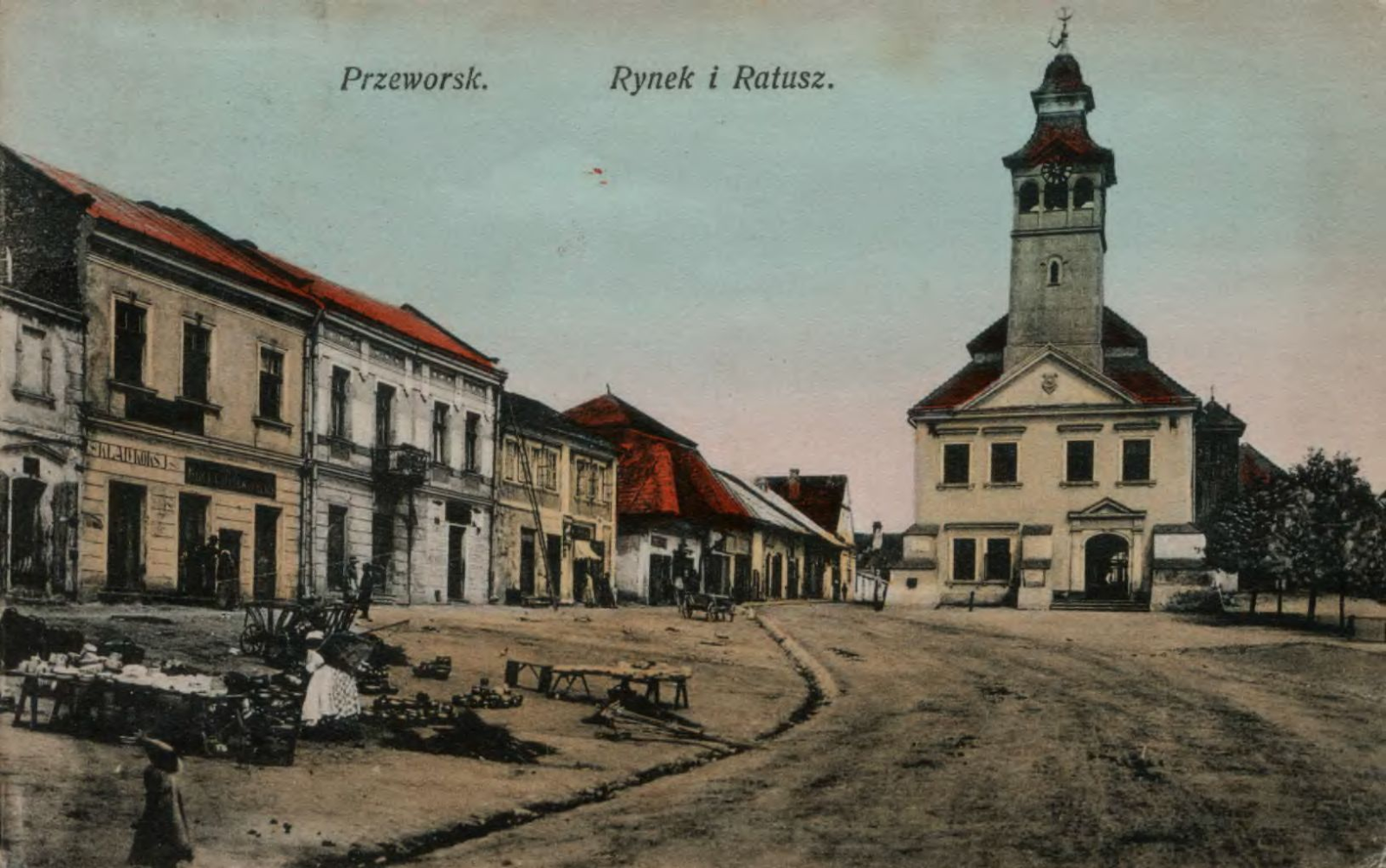
Older people on the rynek sat and chatted, or traversed it, carrying groceries (I'm assuming) home in plastic bags.  The town hall -- the Ratusz -- that I'd seen on old postcards on the web looked freshly refurbished, and most of its front converted into a restaurant.


I walked around snapping pictures, and don't exactly recall what expression if any I noticed on the faces of the people around me.  Nobody else was carrying a camera; Przeworsk is not a tourist destination.  I may have imagined them looking at me in a hostile way; I may have imagined they were those older, more rural Poles, some of whom may have believed that Hitler did them at least one favor, or who may have feared I was snooping around in search of a lost inheritance.


But my grandmother always described her family's situation in Poland as poor.  She would probably have been one part excited to five parts appalled  to know I was ever setting foot in Poland.  I should have taken way more pictures. But it's all there, all available in Google Street View.


The retail buildings surrounding the square looked freshly painted in bright pastels, and some had smaller-town versions of the ornate reliefs you see in European cities.  One had 1912 written under its pediment; my grandmother must have known that one and the ones near it.  And she must have known the Ratusz, with its Przeworsk insignia. Which includes a crescent; some nod to Turkish invaders or Tartars, I think.


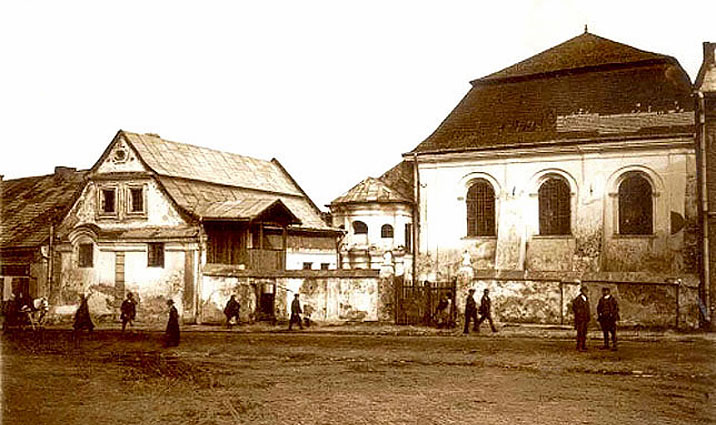
Unlike Jaroslaw ("Yaroslav") and Przemysl ("Pshemish") nearby, Przeworsk has no converted former synagogue to visit. Right off the rynek, peeking behind the Ratusz in some old pictures, it was destroyed.  You can find old black-and-white photos of it by googling Przeworsk synagogue, and Jakub determined that its former location was right on my grandmother's street, Kazimierzkowa. 


If you go on Polish ebay (www.ebay.pl) and search on Przeworsk, as I did just recently, you will find that someone in Germany is selling a rare and jarring photo of its destruction.  (Something from Opa's or great-Grandpa's old cigar box? safe deposit box?)


Jakub, my husband and I walked off the square in the direction of my grandmother's street; on the way we passed an old brick two-story building whose painted door baked in the morning sun; there was an  empty slanted groove in its doorpost, where a mezuzah had been. 


 If you don't count today's vigorous attempts at recreating Jewish community in Krakow and Warsaw, that empty space could stand for the Jewish mark on Poland today; an empty, Jew-shaped space.  You can find these indented spaces all over old doorways, and people do look.  Sometimes they're plastered over but still visible. (In fact, "Mezuzah" is the name of a group dedicated to restoring Jewish places in Poland.) This door's groove was so clear and easy to find that it was clearly deliberately left there for the occasional Jew or curious Pole to find.  And it was on a street perpendicular to Kazimierzkowa.

Now, pictures taken as recently 2005, taken by one Suzanne Wertheim,  show the old, single-story  wooden Jewish houses of Kazimierzkowa street, lopsided and low-roofed, but freshly white-washed and judging by the plants in the windows, inhabited.  One Polish site that shows them refers to them as "charming cottages." But we saw no sign of them on Kazimierszkowa in June 2015.


We couldn't find where 68 Kazimierszkowa Street, mentioned on my uncle's immigration ship manifest, might have been.  The buildings we saw -- mostly two- or three-story apartment houses and one-story businesses -- didn't number that high.  Short story,  the street was totally transformed.  There were no ancient people conveniently available to ask if they'd ever known the Schopfs.  It was just too far back in time. 

  
A young man came out of a store, but when Jakub asked him, he didn't know where 68 might have been, either.  There was a playground at one end of the street and another little park across the street. Behind the grassy strip, tall trees, and past the trees, the backs of charming, more recently built homes with lovely gardens, facing the next street.

We walked back to the rynek and to the Ratusz (town hall), to look for paper records of my family's existence.  According to JewishGen.org and other genealogy sources, all records less than a hundred years old were kept in the local municipalities.

Now that I'm home again, virtually retracing my steps, I see where I should have gone -- to the street that picks up across the intersection, changing its name to Jana Kilińskiego. Here, back  on Google Street View, I see one-story homes that recall the shape and size, if not the facing, of the old, wooden Jewish homes in the old b&w pictures.  And  on that street, an actual original wooden cottage, still occupied when photographed in 2013. 


Sigh...  I did cross that street, but if I'd only walked a few more yards. Perhaps back in 1930,  Kazimierskowa had extended further back, in that Jewish loop of Kazimierskowa, Kilińskiego and Bernardynska, east of the Ratusz/town hall.